
To translate a broch
Dr Alasdair MacCaluim describes the translation of To Build a Broch, an important new learning resource from our archaeology team, into Gaelic. To view in Gaelic, use the button below to toggle the English translation on and off.
Tha an Dr Alasdair MacCaluim a’ toirt cunntas air a bhith ag eadar-theangachadh To Build a Broch / A Thogail Dùn, agus a bhith a’ cruthachadh goireas arc-eòlais cudromach ùr sa Ghàidhlig.
English
I don't have much imagination and never have had. If I go to a historic ruin like a castle or a church, I won't make anything of a written description of what the building looked like when it was whole, new and full of life. I need to see pictures – big colourful pictures.
If you are like me – or if you want to teach archaeology to people like me – there is a new illustrated book in Gaelic for you: A Thogail Dùn: Bho Thogail gu Glèidheadh, by Alan Braby, Andy Heald, Matt Ritchie and Tanja Romankiewicz, published by Forestry and Land Scotland (2022). This book looks at Scottish dùin – or brochs as we call them in English.
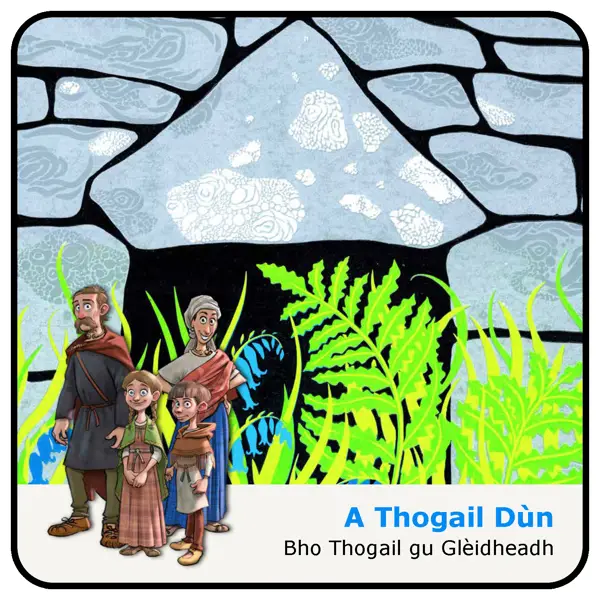
It is aimed particularly at a specific readership – teachers who have a special interest in archaeology and want to teach it. It looks at how to use Scottish brochs as a class project as part of the Curriculum for Excellence (Third Level) combining history, general knowledge and the creative arts, giving pupils the opportunity to study brochs as a topic and to research and present their own brochs.
In the introduction, we learn how to ‘read’ brochs and how to learn about archaeology outdoors. The book then looks at brochs in more depth, considering how they were built, their different types and their place in society. In the chapter Luchd-togail nan Dùn, we see the interior of the imaginary fort of Dùn Seanchas, with pictures of different parts of the broch and people connected to that part of the building who explain them to us.
If one thing is clear from the book, it is that the buildings can be better understood if we learn more about the people who lived within them. I grew up in the 1980s and I well remember a world where there were only three TV channels and no sign yet of videos. It's hard enough to explain to children about the days before smart-phones or the internet – but it's harder still trying to talk to them about people's lives before potatoes, tomatoes or even Christianity!
The book gives us a good picture of the people who used to build and live in the brochs through a series of case studies. The characters in the book tell us about society, how the forts were built and how they were used from different perspectives. We even learn about the type of clothing and jewellery they may have worn – but at the same time, the whole book is clear where there is a lack of information, uncertainty and disagreement about the buildings, the people and society.
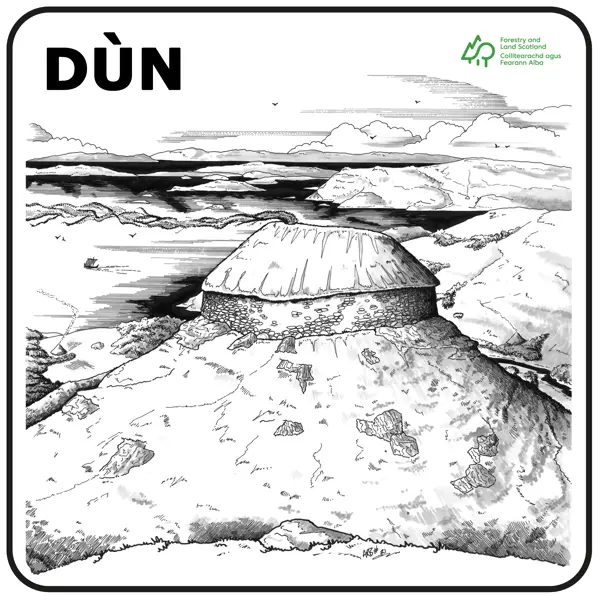
Castle Dounie sits high above the Sound of Jura. It is a good example of a ‘dun’. In archaeological terminology, both complex ‘brochs’ and simple ‘duns’ are Atlantic Roundhouses. Although ‘duns’ come in all sorts of shapes and sizes, they had a similar role as display architecture (c Alan Braby).
As regards Gaelic, there are not many archaeologists who speak Gaelic at present and I think it would be correct to say that there are even fewer who work through Gaelic or write about their work through in the language. This is gradually changing and indeed, Dig It! (from the Society of Antiquaries of Scotland) recently presented a series of blogs in Gaelic (and indeed Scots) about archaeology aimed at young people.
Because there isn't much written about archaeology in Gaelic, I was a bit nervous when asked to translate To Build a Broch into Gaelic. I was already interested in the subject, having studied Scottish History at university, and undertaken translations on subjects connected to ancient history and archaeology before. However, there is a bit of a lack of Gaelic vocabulary on this subject and, while Historic Environment Scotland's glossary of the historic environment was very useful, there were plenty of words not in the dictionary. I had to think hard about many of them. A specialist Gaelic dictionary of archaeological terminology would be very useful.
To give just one example, although our Gaelic word for broch is dùn, the word dun is also used in English – but is used for a slightly different type of building to what we would call a dùn in Gaelic!
But that's enough about the translator's life! What about the life of the archaeologist? How do we know how the forts were used? How do we know from ruins what they were like when they were new and intact? We find out about the life and work of the archaeologists throughout the book, but especially in the chapter Dùn-eòlas, in which individual archaeologists tell us about conserving, excavating, recording and interpreting their own brochs. If you like all of this – and who wouldn’t – the book ends with a message for young people who want to be archaeologists.
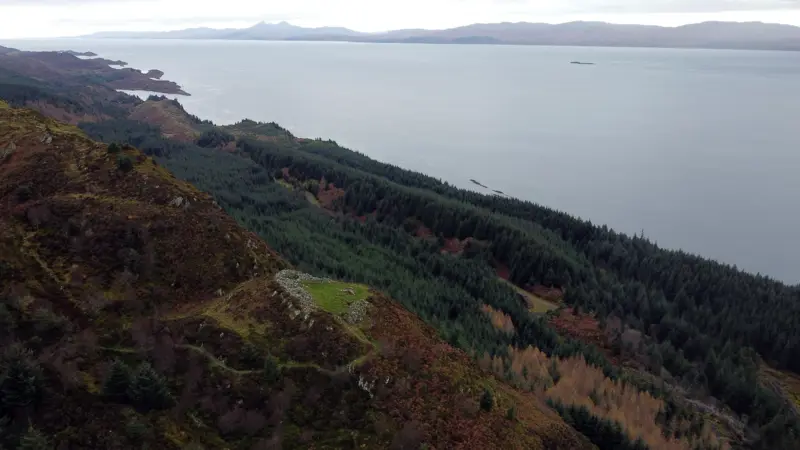
View of the remains of Castle Dounie from above
This is an excellent book that adds something new and dynamic to Gaelic educational resources. I would recommend this book to any teacher in Gaelic education who is interested in archaeology.
And according to Gillebride MacMillan, Gaelic teacher and scholar:
“Tha an leabhar eireachdail seo fiosrachail agus tarraingeach do shean agus òg. Còrdaidh seo ri sgoilearan agus bidh e gu feum do thidsearan a tha ag iarraidh teagasg mu arc-eòlas tro mheadhan na Gàidhlig. Mholainn gu mòr an leabhar seo.”
“This wonderful book is informative and engaging for young and old. Pupils will like this and it will be useful for teachers who want to teach about archaeology through the medium of Gaelic. I would highly recommend this book.”
If you would like a copy of A Thogail Dùn: Bho Thogail gu Glèidheadh, visit the Gaelic Books Council or download a PDF copy below.
Gaelic
Tha an Dr Alasdair MacCaluim a’ toirt cunntas air a bhith ag eadar-theangachadh To Build a Broch / A Thogail Dùn, agus a bhith a’ cruthachadh goireas arc-eòlais cudromach ùr sa Ghàidhlig.
Chan eil mac-meanmna sam bith agam is cha robh riamh. Ma thèid mi gu tobhta eachdraidheil leithid caisteal no eaglais, cha dèan mi steam de mhìneachadh sgrìobhte air cò ris a bha an togalach coltach nuair a bha e slàn, ùr agus làn beatha. Feumaidh mi dealbhan – dealbhan mòra dathach.
Ma tha thu mar a tha mi fhèin – no ma tha thu airson arc-eòlas a theagasg do dhaoine mar mi fhèin – tha leabhar ùr sa Ghàidhlig ann le dealbhan dhut: A Thogail Dùn: Bho Thogail gu Glèidheadh, le Alan Braby, Andy Heald, Matt Ritchie agus Tanja Romankiewicz, foillsichte le Coilltearachd is Fearann Alba (2022). Tha an leabhar seo a’ coimhead air dùin – no brochs mar a chanar riutha sa Bheurla - ann an Alba.
Tha e ag amas air luchd-leughaidh sònraichte – luchd-teagaisg aig a bheil ùidh shònraichte ann an arc-eòlas agus a tha airson a theagasg. Tha e a’ sealltainn mar a chleachdar dùin na h-Alba mar chuspair clas mar phàirt den Churraicealam airson Sàr-mhathais (Treas Ìre) a’ measgachadh eachdraidh, cruinn-eòlas agus na h-ealainean cruthachail. Bheir e cothrom do sgoilearan dùin a sgrùdadh mar chuspair agus na dùin aca fhèin a rannsachadh agus a thaisbeanadh.
Anns an fhacal toisich, thathar a’ mìneachadh mar a ‘leughar’ dùin agus mar a dh’ionnsaichear mu arc-eòlas a-muigh. Tha an leabhar an uair sin a’ coimhead air dùin ann am barrachd doimhneachd, mar a chaidh an togail, air na diofar sheòrsaichean aca agus air an àite aca san t-sòisealtas. Sa chaibideil Luchd-togail nan Dùn, tha sinn a’ faicinn taobh a-staigh an dùin mhic-meanmnach Dùn Seanchas, le dealbhan de dhiofar phàirtean den dùn agus de dhaoine le ceanglaichean den phàirt sin den togalach a tha ag innse dhuinn mu dheidhinn.
Ma tha aon rud soilleir bhon leabhar, ’s e gum faighear tuigse nas fheàrr air na togalaichean ma dh’ionnsaicheas sinn barrachd mu na daoine a bha a’ tighinn beò annta. Dh’fhàs mi suas anns na 1980an agus tha cuimhne agam air saoghal far nach robh ach trì seanailean TBh is gun sgeul air bhideothan. Tha e doirbh gu leòr a bhith a’ mìneachadh do chloinn mu na làithean mus robh fònaichean-tapaidh no an t-eadar-lìon ann – ach tha e nas dorra buileach a bhith a’ feuchainn ri bruidhinn riutha air beatha dhaoine mus robh buntàta, tomatothan no fiù ’s Crìosdaidheachd ann!
Tha an leabhar a’ toirt dhuinn deagh dhealbh de na daoine a bhiodh a’ togail agus a’ fuireach anns na dùin tro shreath de sgrùdaidhean cùise. Tha na caractaran san leabhar ag innse dhuinn mun chomann-shòisealta, mar a chaidh na dùin a thogail is a chleachdadh bho dhiofar sheallaidhean. Tha sinn fiù ’s ag ionnsachadh mun t-seòrsa aodach is seudraidh a dh’fhaodadh a bhith orra – ach aig an aon àm, tha an leabhar air fad soilleir far a bheil dìth-fiosrachaidh, mì-chinnt is eus-aonta ann mu na toglaichean, na daoine agus mun t-sòisealtas.
Tha Caisteal Dùinidh àrd os cionn Linne Dhiùra. Tha e na dheagh eisimpleir de ‘dun’. Ann am briathrachas arc-eòlais, tha an dà chuid ‘brochs’ iom-fhillte agus ‘duns’ sìmplidh nan Taighean Cruinn a’ Chuan Siar. Ged a tha ‘duns’ ann den a h-uile seòrsa cumadh is meud, bha an aon seòrsa ròl aca mar ailtireachd taisbeanaidh (c Alan Braby).
A thaobh na Gàidhlig, chan eil mòran arc-eòlaichean ann aig a bheil Gàidhlig aig an àm seo agus saoilidh mi gum biodh e ceart ri ràdh gu bheil nas lugha buileach ann a tha ag obair tron Ghàidhlig no a’ sgrìobhadh mu dheidhinn tron Ghàidhlig. Tha seo ag atharrachadh mean air mhean agus gu dearbha, rinn Dig It! (bho Chomann Àrsairean na h-Alba) sreath de bhlogaichean sa Ghàidhlig (agus gu dearbha, sa Bheurla-Ghallda) bho chionn ghoirid mu arc-eòlas a bha ag amas air òigridh.
A chionn ’s nach eil cus sgrìobhte mu arc-eòlas sa Ghàidhlig, bha mi rud beag iomagaineach nuair a chaidh iarraidh orm Gàidhlig a chur air To Build a Broch. Bha ùidh agam sa chuspair mar-thà oir rinn mi Eachdraidh na h-Alba san oilthigh agus tha mi cuideachd air eadar-theangachadh a dhèanamh air cuspairean co-cheangailte ri arc-eòlas agus seann-eachdraidh roimhe. Ach, tha gainnead briathrachais ann gu ìre agus ged a bha co-fhaclair na h-àrainneachd eachdraidheil aig Àrainneachd Eachdraidheil Alba gu math feumail bha gu leòr fhaclan nach robh ann. Bha agam ri smaoineachadh gu cruaidh air tòrr de na faclan. Bhiodh faclair speisealach de bhriathrachas arc-eòlais gu math feumail.
Gus dìreach aon eisimpleir a thoirt seachad, ged is e dùn a’ Ghàidhlig a th’ againn air broch, tha am facal dun ga chleachdadh sa Bheurla cuideachd ach thathar ga chleachdadh airson seòrsa togalaich rud beag eadar-dhealaichte ris an rud ris an canamaid dùn sa Ghàidhlig!
Ach sin gu leòr mu bheatha an eadar-theangair! Dè mu dheidhinn beatha an arc-eòlaiche? Ciamar a tha fios againn mu mar a chaidh na dùin a chleachdadh? Ciamar a tha fios againn bho na tobhtaichean dè an cruth a bha orra nuair a bha iad ùr is slàn? Tha sinn a’ faighinn a-mach mu bheatha is obair nan àrc-eòlaichean tron leabhar air fad ach gu sònraichte sa chaibideil Dùn-eòlas anns a bheil arc-eòlaichean fa leth a’ coimhead air a bhith a’ glèidheadh, a’ cladhadh, a’ clàradh, agus ag eadar-mhìneachadh diofar dhùin. Ma tha seo a’ còrdadh riut – agus cò ris nach còrdadh e – tha an leabhar a’ tighinn gu crìch le fios do dh’òigridh a tha ag iarraidh a bhith nan arc-eòlaichean.
View of the remains of Castle Dounie from above
Is e sàr-leabhar a tha seo a tha a’ cur rudeigin ùr is beothail ri goireasan foghlaim Gàidhlig. Mholainn an leabhar seo do neach-teagaisg sam bith ann am foghlam tron Ghàidhlig aig a bheil ùidh ann an arc-eòlas.
Agus a rèir Gillebride Mac 'IlleMhaoil, neach-teagaisg agus sgoilear Gàidhlig:
“Tha an leabhar eireachdail seo fiosrachail agus tarraingeach do shean agus òg. Còrdaidh seo ri sgoilearan agus bidh e gu feum do thidsearan a tha ag iarraidh teagasg mu arc-eòlas tro mheadhan na Gàidhlig. Mholainn gu mòr an leabhar seo.”
Ma tha thu ag iarraidh lethbhreac de A Thogail Dùn: Bho Thogail gu Glèidheadh, tadhal air làrach-lìn Comhairle nan Leabhraichean.