Forestry and Land Scotland Logo
  1. Visit
      1. Find a forest
      2. Explore forest parks
    1. Accessible forests
    2. Stay the night
      1. Waymarked trails
      2. Cycling
      3. Mountain biking
      4. Photography
      5. Orienteering
      6. Camping
      7. Treetop adventure
      8. Water sports
      9. Horse riding
      1. Things to see
      2. Trees
      3. Wildlife
      4. Heritage
      5. Things to see in Winter
    3. Plan a visit with a group
    4. Visiting safely
    5. Parking
    Forest map

    Search for a forest by map

    Forests & trails information and closures

    An overview of all closures and high risk warnings on trails.

    Stay the night

    Park overnight in selected forest car parks as part of our motorhome scheme.

  2. About us
      1. Who we are
      2. Our mission and vision
      3. Leadership team
      4. Our values
      1. Careers
      2. Current Vacancies
      3. What we offer
      4. Candidate information
      5. A day in the life
      6. Apprenticeships
    1. Key documents
    2. Our impact
    3. Our approach to Gaelic
    Current Vacancies

    Some text

  3. What we do
      1. Taking Climate Action
      2. The climate emergency
      3. Forest resilience
      4. Peatland restoration
      5. Carbon offsetting
      6. Biodiversity
      7. Renewable energy
      1. Managing the land
      2. Planning our land management
      3. Our sustainable forestry
      4. Our tree nursery
      1. Conservation
      2. Habitat conservation
      3. Wildlife conservation
      4. Historic environment conservation
    1. Supporting outdoor exploration
    2. Working with communities
    3. Our projects
  4. Living and Working
      1. For businesses
      2. Timber sales
      3. Procurements and tenders
      4. Business opportunities
      5. Farming opportunities
      6. Venison sales
      7. Firewood sales
      1. For communities
      2. Transfer land and buildings to your community
      3. Land management plan consultations
      1. Permissions and Permits
      1. Learning and Education
      2. Outdoor learning
      3. Activity sheets
    1. Buy Land or Buildings
    Land management plan consultations

    Text here

    Current job opportunities

    Text here

  5. Get involved
    1. Have your say on consultations
    2. Hold an event
    3. Apply for a community asset transfer (CAT)
    4. Arrange a visit
    5. Work with us
  6. News
  7. Contact
Suggested links
    1. Home
    2. News
    02 September 2022 4 minutes

    The technology helping us modernise forestry

    Forestry is evolving. We're using more and more modern technology to help us work in tricky and hard-to-reach areas, though we do still fell trees with a chainsaw and plant by hand.

    From zip-lining massive logs, to using satellites to herd cows and laser beams to map archaeological sites, we are testing and developing new technology every year to help us do our job better and more efficiently. 

    Zip-lined logs 
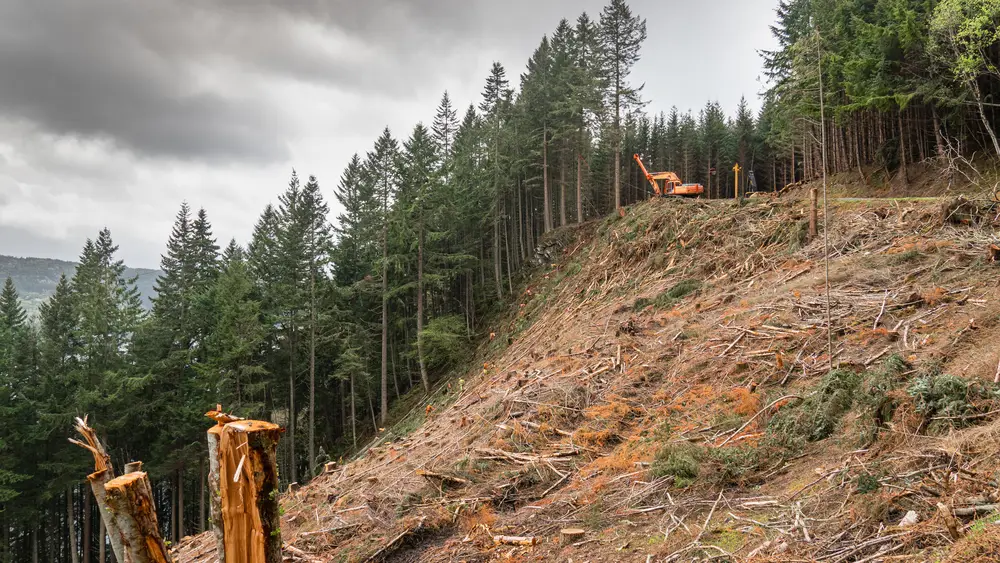
    Equipment hauling large logs off the hillside

    Skylining is relatively niche in Scotland, but it’s proven to be a good fit – especially in the Highlands.

    We’re currently using Skylining along the A82, near Loch Ness, to safely remove Douglas firs from the steep hillside. Our skilled contractors fell the trees using only a chainsaw and wedge. They then section the tree before hauling it off the hillside using the massive Skylining system, which looks like a giant industrial zip-line. 

    These Douglas first were planted around 80-years-ago, however, they're now getting too big for the habitat, so we're removing them to help prevent landslips.

    The land will return to native oak woodland through natural regeneration.

    Learn more about the A82 project

    Seed planting drones 
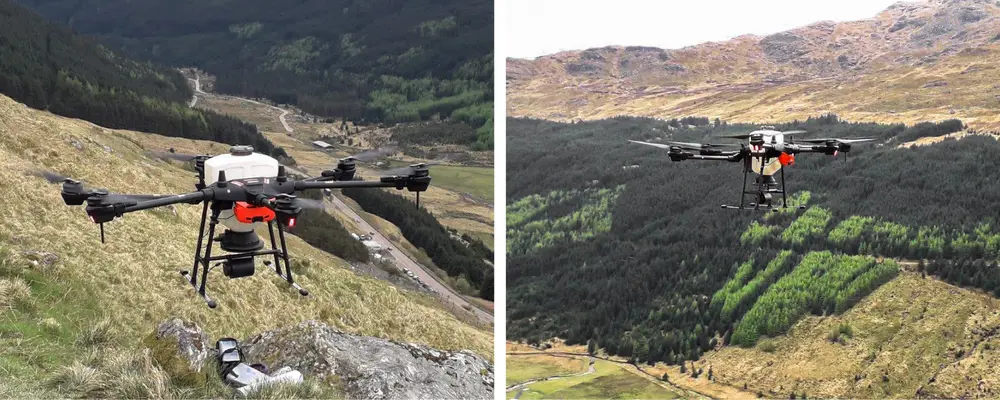
    two shots of a drone planting tree seeds

    Planting trees on steep hillsides can be tricky. This year we trialled the use of drones to help us plant seeds along the A83 at the Rest and Be Thankful. In just two days, the drones planted six hectares of the steep hillside with native broadleaf trees.

    The goal of this partner-led project is to stabilise the slopes next to the road to prevent further landslips. Though this is quite common in other parts of the world, it's new to Scotland.

    This year’s test focused on calibrating the equipment and on the flight patterns across the slope to see how far, fast and just how high we needed to fly the drone to disperse the seed into exposed mineral areas of the core instability.download.gif

    We will be monitoring the site until next spring to see how many seedlings emerge before starting the second round of tests. 

    Learn more about the A83 drone testing
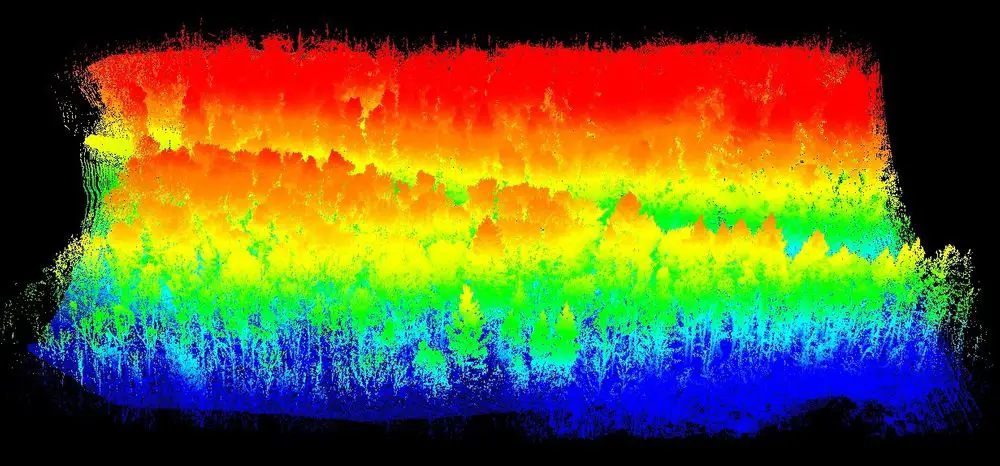
     

    Thermal imaging of a forest

    Thermal imaging drones

    We are also trialling the use of drones to help capture thermal images of deer. This will help us track deer numbers around an enclosed conservation woodland at Loch Katrine.

    Deer populations are thought to have doubled in the past 30 years and can have negative impacts on our forests and land. The ability to get a better sense of number of deer and monitor the population living in and around Loch Katrine will help us manage the deer in this area in a more sustainable way. 

    We’re currently looking to renew the land management plan around Loch Katrine, aiming to create 2000 hectares of new woodland with less fencing.

    Learn more about thermal imaging drones

    GPS collared cows 
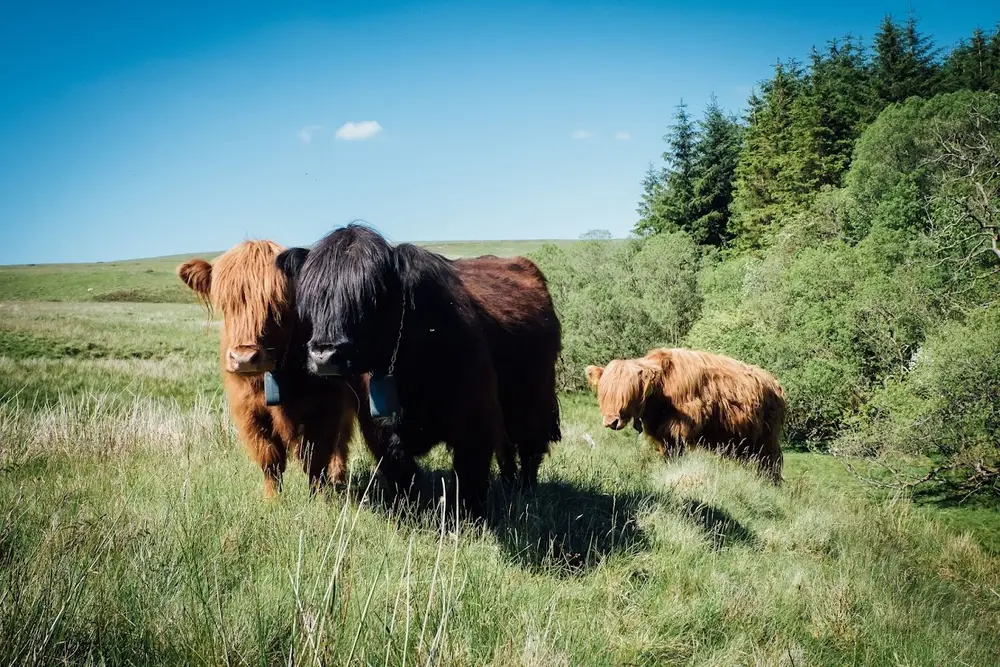
    three cows with GPS collars in a field next to a woodland

    Cows have long been used for ‘conservation grazing’, as a management tool for a number of projects such as helping to create habitats for rare butterflies in forests like Mabie.  

    The issue is that some of our sites requiring conservation grazing are remote and often in areas where we can’t build or maintain physical fences.  This is where virtual fence collars may be able to help.  

    This project is a first for us. It uses GPS collars connected to a satellite, which then creates a digital fence line. If the cow wanders too close to the boundary, it's given a series of audio warnings prompting it to stay within the boundary. The system will allow the cattle to graze safety over large distances without the need for physical fencing, which will allow them to keep being effective tools for broadleaf regeneration and other conservation management regimes.

    Learn more about how we use GPS collars

    Logging laser beams  
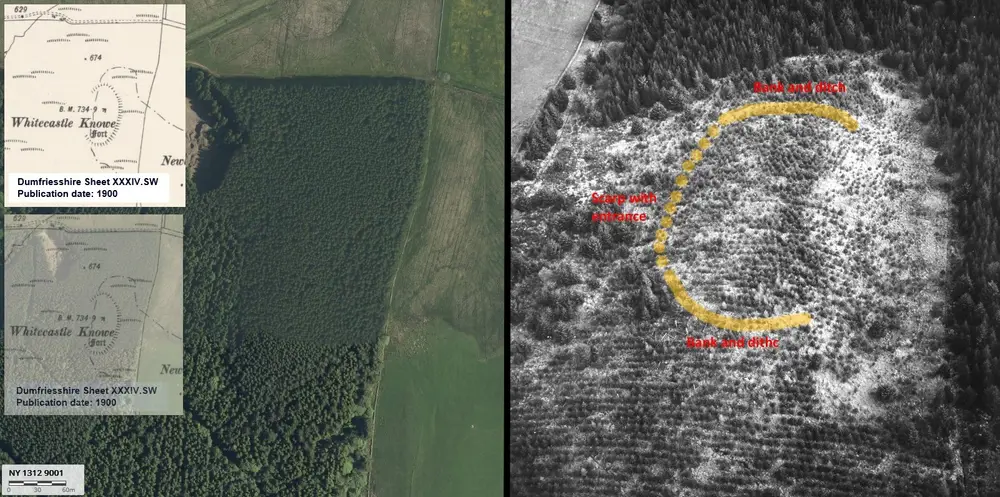
    digital laser scans of a forest

    Terrestrial laser scanning and airborne Lidar use a laser beam pulsed from a sensor many thousands of times per second.  The sensor records the echoes of the beam as it bounces back from the surface being scanned.

    This creates a digital 3D model. Our Archaeologist can use these 3D models to create detailed records of ancient ruins and historic landscapes, identifying and recording past settlement patterns and land use. 

    Techniques such as airborne Lidar can also be used to inform our harvesting operations.  When the laser beams reflect both the forest canopy and the forest floor, the canopy can be removed to reveal the hidden details. This gives us some insight on the area before we start work – including details such as the ramparts of the hillfort of Whitecastle Knowe in Dumfriesshire.


    Latest from FLS

    1. 12 Jan 2026

      Lesley's article

    2. 03 Oct 2025

      Scotland's Climate Week 2025: Working together in the Angus Glens

    3. 29 Sep 2025

      Scotland's Climate Week 2025: Working with partners to support beaver populations

    4. 19 Sep 2025

      Martens on the Move at Kirroughtree

    5. 20 Aug 2025

      Protecting endangered apple trees through teamwork

    Share this article

    • Share on Facebook
    • Share on X
    • Share on LinkedIn

    Feedback

    There is a problem

    Feedback

    Thank you for your feedback

    User feedback form


    Your feedback helps us to improve this website. Do not give any personal information because we cannot reply to you directly.


    Your feedback helps us improve this website. Do not provide any personal information here. If you need to get in touch with a query, please contact us.


    Your feedback helps us improve this website. Do not provide any personal information here. If you need to get in touch with a query, please contact us.

    Forestry and Land Scotland Logo

    Follow us on

    • Forestry and Land Scotland on Facebook
    • Forestry and Land Scotland on Twitter
    • Forestry and Land Scotland on Instagram
    • Forestry and Land Scotland on LinkedIn

    Utilities

    1. Accessibility
    2. Cookies
    3. Privacy Notice
    4. Terms and Conditions
    5. Freedom of Information
    6. Modern Slavery Statement

    Quick links

    1. Media Centre
    Forest Stewardship Council, the mark of responsible forestry Programme for the Endorsement of Forest Certification, PEFC
    © Crown Copyright
    Forests and land that Scotland can be proud of Link to gov.scot gov.scot