
Tech helping to give Scotland’s rainforests breathing room
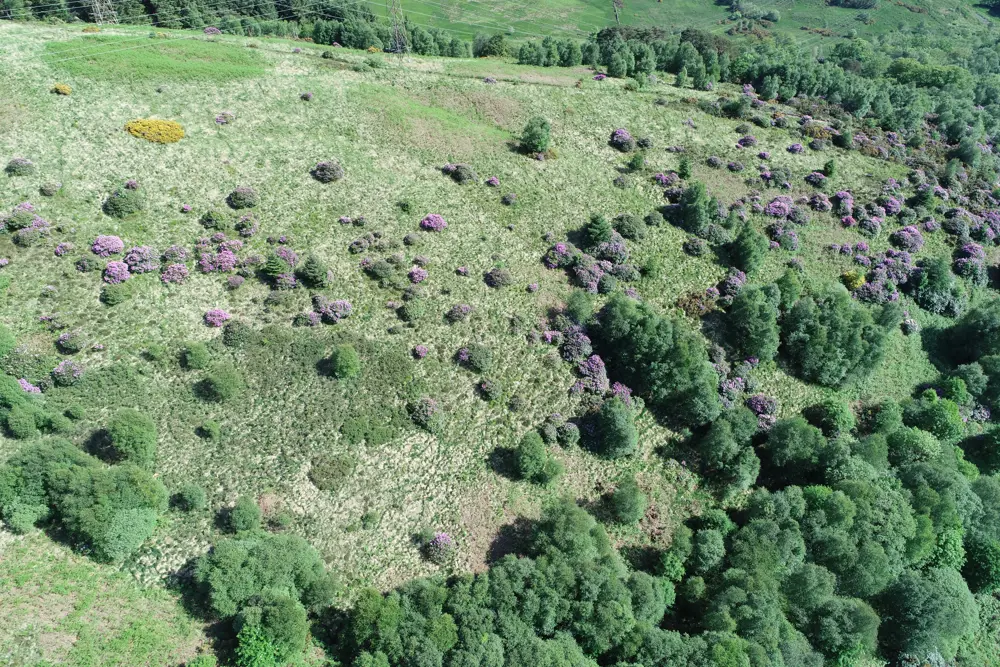
We are using technology more and more to help us modernise forestry to make it safer and more efficient. Most recently we started to see how we can use drone to map out where rhododendron needs to be controlled.
We have been working for over 25 years to turn back the relentless tide of invasive rhododendron that is smothering much of the west coast and threatening unique rainforest habitat. Removing this scrub more efficiently will help give our rainforest the breathing room it needs to recover.
Rhododendron ponticum (referred to simply as rhododendron in the rest of this blog) is an aggressively spreading invasive non-native species that can prevent natural processes within any woodland and kill off the native ground covering plants that serve as the base-layer for habitats and reduce that woodlands suitability for other wildlife.
“We’ve made steady progress in a lot of areas but the two most effective advances in recent years have undoubtedly been that advent of drones and a greater degree of cooperation and improved partnership working.”
Said our National Environmental Manager Colin Edwards.
The aerial view given by the drones gives us a unique viewpoint that can help us assess the extent of the issue. This can guide our decisions to prioritise, plan and execute our treatment operations to make them more effective.
This new way to rapidly and efficiently map the rhododendron is giving us a better picture as to what we are dealing with and helping us to show that we need to work with other landowners and partners in order to deal with this .
“Cooperation between land managers works, as can be seen in Glen Creran, which thanks to a four-year community project led by the Argyll and the Isles Coast and Countryside Trust, is now free of rhododendron.” added Colin.
Our goal for rhododendron control in the rainforest zone is to work at scale, this requires the help of everyone to tackle this fast-growing weed and prevent it from re-seeding. Knowing where all potential flowering bushes are present helps to reduce the possibility that cleared sites will be re-invaded, and invaded and being able to identify where the most mature seed-bearing plants are enables large populations to be tackled in a systematic manner.
Missing even just one plant can result in the re-introduction of the plant to the area.
‘What we consider and call invasive rhododendron is complicated by the fact that the mature parent plants are both a species and a hybrid plant based on Rhododendron ponticum. That species, originally from the Iberian peninsula, was crossed with two other rhododendron species’ said Colin.
Colin explained that the shrub came from a race between two well established botanical gardens to create a hybrid plant used as a root stock for grafting other rhododendron species. Rhododendron is tolerant to our low nutrient acidic soils and thrives in our wet western climate. That combined with particular traits of rhododendron make it particularity hard to get rid of. However, the invasive tendencies and spread of seedlings is mainly from the pure species R ponticum, although hybrids probably contribute to this spread in some locations.
In the past, controlling rhododendron was done mainly by ‘cut and burning’ it, this is a resource intensive and slow method where each and every plant had to be handled several times, and included the creation of stacks of plant material to enable burning. Only then could residual root systems be treated with herbicides, or in some cases sites were left for several years for the roots to regrow young shoots, and these were then treated with herbicide.
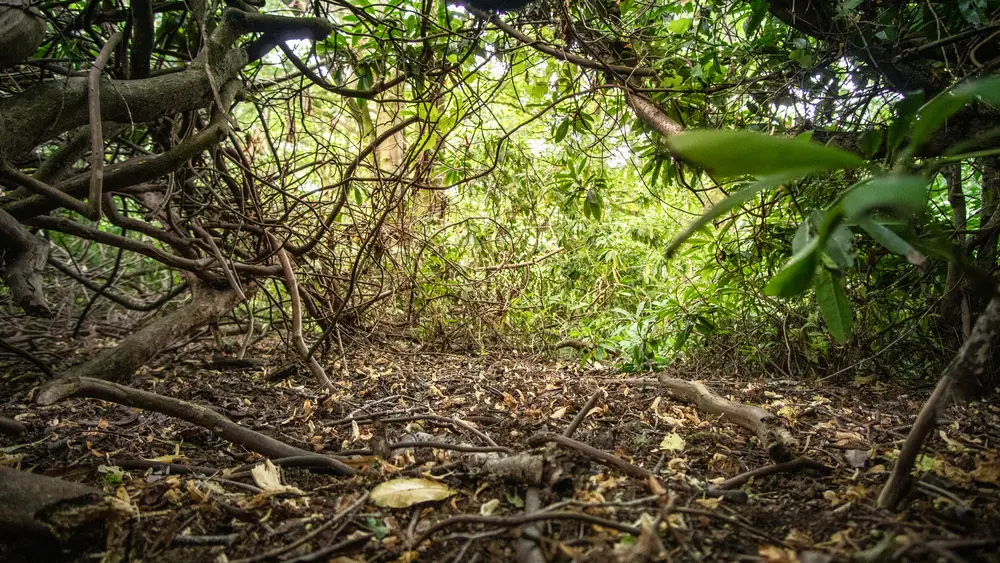
What a rhododendron bush looks like under it's green canopy.
The future of rhododendron control
Colin was a part of the team at Forest Research who developed the more efficient stem injection technique. This methodology takes half the time and when applied correctly has a 90-100% success rate, significantly reducing the need for re-treatments, and reducing the risks to non-target plants and the wider environment.
As part of our new rainforest strategy, we will be starting to implement stem injection more and more, which for Colin is exciting to be part of. He started working on the research and development of this issue over 20 years ago and now is part of a landscape scale implementation of that work.
‘It will only be through coordinated management of meta-populations with long-term monitoring and repeat control, that these invasive non-native bushes will be pushed back sufficient to enable our natural habitats to thrive once again’ adds Colin.
Learn more about stem-injection
In the past decade we have treated around 11,000 hectares of rhododendron, requiring the investment of £13.5 million to expand the restoration of Scotland’s rainforests.