Forestry and Land Scotland Logo
  1. Visit
      1. Find a forest
      2. Explore forest parks
    1. Accessible forests
    2. Stay the night
      1. Waymarked trails
      2. Cycling
      3. Mountain biking
      4. Photography
      5. Orienteering
      6. Camping
      7. Treetop adventure
      8. Water sports
      9. Horse riding
      1. Things to see
      2. Trees
      3. Wildlife
      4. Heritage
      5. Things to see in Winter
    3. Plan a visit with a group
    4. Visiting safely
    5. Parking
    Forest map

    Search for a forest by map

    Forests & trails information and closures

    An overview of all closures and high risk warnings on trails.

    Stay the night

    Park overnight in selected forest car parks as part of our motorhome scheme.

  2. About us
      1. Who we are
      2. Our mission and vision
      3. Leadership team
      4. Our values
      1. Careers
      2. Current Vacancies
      3. What we offer
      4. Candidate information
      5. A day in the life
      6. Apprenticeships
    1. Key documents
    2. Our impact
    3. Our approach to Gaelic
    Current Vacancies

    Some text

  3. What we do
      1. Taking Climate Action
      2. The climate emergency
      3. Forest resilience
      4. Peatland restoration
      5. Carbon offsetting
      6. Biodiversity
      7. Renewable energy
      1. Managing the land
      2. Planning our land management
      3. Our sustainable forestry
      4. Our tree nursery
      1. Conservation
      2. Habitat conservation
      3. Wildlife conservation
      4. Historic environment conservation
    1. Supporting outdoor exploration
    2. Working with communities
    3. Our projects
  4. Living and Working
      1. For businesses
      2. Timber sales
      3. Procurements and tenders
      4. Business opportunities
      5. Farming opportunities
      6. Venison sales
      7. Firewood sales
      1. For communities
      2. Transfer land and buildings to your community
      3. Land management plan consultations
      1. Permissions and Permits
      1. Learning and Education
      2. Outdoor learning
      3. Activity sheets
    1. Buy Land or Buildings
    Land management plan consultations

    Text here

    Current job opportunities

    Text here

  5. Get involved
    1. Have your say on consultations
    2. Hold an event
    3. Apply for a community asset transfer (CAT)
    4. Arrange a visit
    5. Work with us
  6. News
  7. Contact
Suggested links
    1. Home
    2. News
    10 June 2022 3 minutes

    Storm damage to help riparian restoration
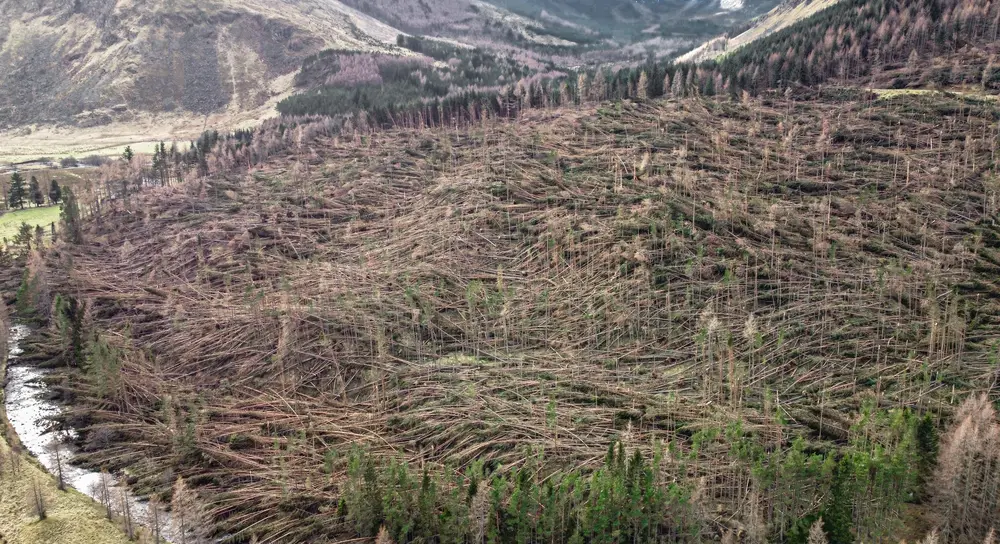
    Storm damage in forest

    The damage caused by storms Arwen and Corrie could speed up efforts to restore a strip of land along the River South Esk and the White Water in Glen Doll, Angus.

    About a third of conifers on this site came down.

    These conifers would have been slowly removed in the next 30 – 40 years to widen and improve the riparian zone running through the forest. The recent storms have sped up this process… once we’ve cleaned up the mess, that is.

    Riparian restoration is a key element in our land management planning across Scotland. The aim is to replace conifers that are near river systems with native broadleaf nature corridors.

    These are important areas for biodiversity and help mitigate the rising river temperatures we are seeing due to climate change. The west region has already planted over 6,000 native trees such as alder, birch, aspen, bird cherry and hazel. These conifers will be replaced similarly.

    Learn more about riparian zones
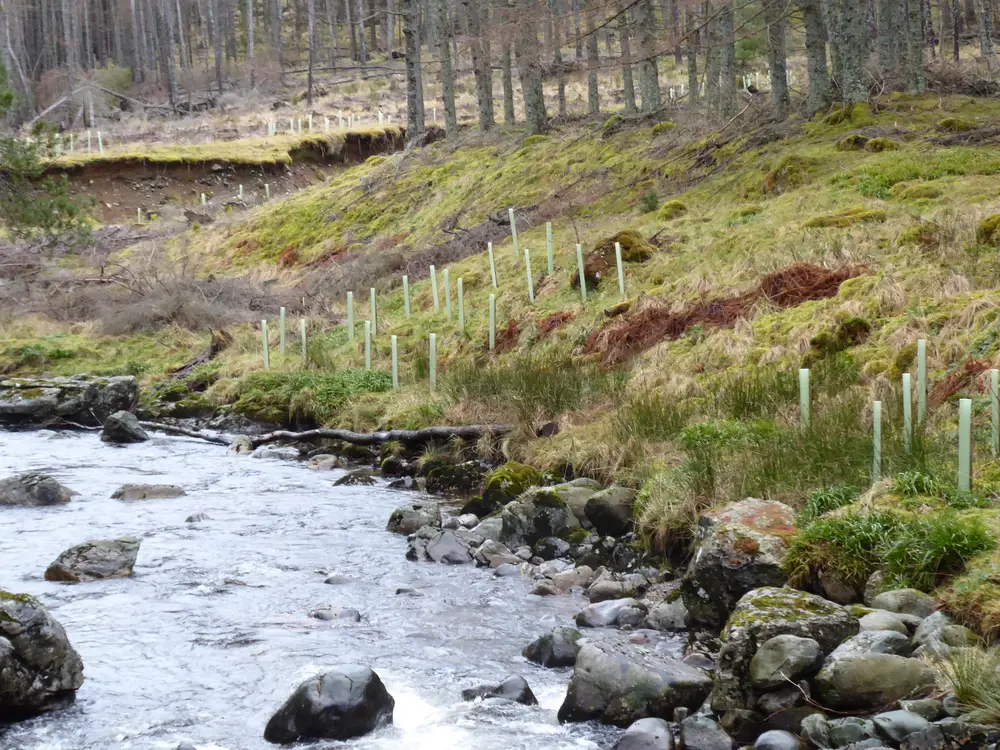
     New trees planted next to riverAn example of riparian zone planting elsewhere in the region.

    Gareth Ventress, environment forester at FLS, said:

    “Species such as otter, brown trout and Atlantic salmon really depend on healthy aquatic and riparian habitats. Restoring riparian zones is hugely beneficial for them, as well as the overall health and vitality of rivers and streams. 

    “They also provide the arteries of connectivity throughout a landscape. They link a variety of habitats and provide safe access routes for a range of species, from fast-moving mammals and birds to slow-moving, but equally important and often rare invertebrates, lichens and mosses.

    “Planting native woodland helps keep the water chemistry balanced and provides shade to help regulate the temperature of the water. It also provides a food source for fish and animals as falling leaves and insects drop into the water.”

    The benefits continue even after the trees die, explained Ventress.

    “Different invertebrates move in to feed on or make their homes in the dead and rotting wood, which goes on to feed small mammals, birds and fish.

    “In the River South Esk, we’ve discussed keeping 15 - 20 windblown conifers complete with their root plates attached. These will be added to the watercourse in consultation with NatureScot and with the partners in the River South Esk Catchment Partnership for large woody debris. This woody debris creates habitat niches by creating different depths and water flow within the river, boosting biodiversity under the water.”

    The site will be monitored over 10 years to ensure that the new trees thrive and that conifer regeneration, which would threaten to over-shade them, is not allowed to take hold. We will continue to build on the work of this project and earlier riparian planting by adding more native trees along the catchment as the forest is restructured and with the eventual inclusion of less common trees and shrubs like dark-leaved willow and juniper. Glen Doll’s trails remain closed to visitors while the team clears storm debris.

    Learn more about riparian zones on our podcast


    Latest from FLS

    1. 12 Jan 2026

      Lesley's article

    2. 03 Oct 2025

      Scotland's Climate Week 2025: Working together in the Angus Glens

    3. 29 Sep 2025

      Scotland's Climate Week 2025: Working with partners to support beaver populations

    4. 19 Sep 2025

      Martens on the Move at Kirroughtree

    5. 20 Aug 2025

      Protecting endangered apple trees through teamwork

    Share this article

    • Share on Facebook
    • Share on X
    • Share on LinkedIn

    Feedback

    There is a problem

    Feedback

    Thank you for your feedback

    User feedback form


    Your feedback helps us to improve this website. Do not give any personal information because we cannot reply to you directly.


    Your feedback helps us improve this website. Do not provide any personal information here. If you need to get in touch with a query, please contact us.


    Your feedback helps us improve this website. Do not provide any personal information here. If you need to get in touch with a query, please contact us.

    Forestry and Land Scotland Logo

    Follow us on

    • Forestry and Land Scotland on Facebook
    • Forestry and Land Scotland on Twitter
    • Forestry and Land Scotland on Instagram
    • Forestry and Land Scotland on LinkedIn

    Utilities

    1. Accessibility
    2. Cookies
    3. Privacy Notice
    4. Terms and Conditions
    5. Freedom of Information
    6. Modern Slavery Statement

    Quick links

    1. Media Centre
    Forest Stewardship Council, the mark of responsible forestry Programme for the Endorsement of Forest Certification, PEFC
    © Crown Copyright
    Forests and land that Scotland can be proud of Link to gov.scot gov.scot