Forestry and Land Scotland Logo
  1. Visit
      1. Find a forest
      2. Explore forest parks
    1. Accessible forests
    2. Stay the night
      1. Waymarked trails
      2. Cycling
      3. Mountain biking
      4. Photography
      5. Orienteering
      6. Camping
      7. Treetop adventure
      8. Water sports
      9. Horse riding
      1. Things to see
      2. Trees
      3. Wildlife
      4. Heritage
      5. Things to see in Winter
    3. Plan a visit with a group
    4. Visiting safely
    5. Parking
    Forest map

    Search for a forest by map

    Forests & trails information and closures

    An overview of all closures and high risk warnings on trails.

    Stay the night

    Park overnight in selected forest car parks as part of our motorhome scheme.

  2. About us
      1. Who we are
      2. Our mission and vision
      3. Leadership team
      4. Our values
      1. Careers
      2. Current Vacancies
      3. What we offer
      4. Candidate information
      5. A day in the life
      6. Apprenticeships
    1. Key documents
    2. Our impact
    3. Our approach to Gaelic
    Current Vacancies

    Some text

  3. What we do
      1. Taking Climate Action
      2. The climate emergency
      3. Forest resilience
      4. Peatland restoration
      5. Carbon offsetting
      6. Biodiversity
      7. Renewable energy
      1. Managing the land
      2. Planning our land management
      3. Our sustainable forestry
      4. Our tree nursery
      1. Conservation
      2. Habitat conservation
      3. Wildlife conservation
      4. Historic environment conservation
    1. Supporting outdoor exploration
    2. Working with communities
    3. Our projects
  4. Living and Working
      1. For businesses
      2. Timber sales
      3. Procurements and tenders
      4. Business opportunities
      5. Farming opportunities
      6. Venison sales
      7. Firewood sales
      1. For communities
      2. Transfer land and buildings to your community
      3. Land management plan consultations
      1. Permissions and Permits
      1. Learning and Education
      2. Outdoor learning
      3. Activity sheets
    1. Buy Land or Buildings
    Land management plan consultations

    Text here

    Current job opportunities

    Text here

  5. Get involved
    1. Have your say on consultations
    2. Hold an event
    3. Apply for a community asset transfer (CAT)
    4. Arrange a visit
    5. Work with us
  6. News
  7. Contact
Suggested links
    1. Home
    2. News
    22 March 2021 4 minutes

    Rock-Art-Ology

    Our new learning resource, A Song in Stone, explores Scotland’s amazing outdoor gallery of ancient rock art – abstract designs of cup and ring marks that our Neolithic ancestors carved over 4,000 years ago.

    The booklet is packed with fresh ideas, stunning photography and great illustrations. To celebrate its publication, our archaeologist Matt is calling for aspiring young archaeologists and ecologists to get creative!

    Matt explains:

    We took an archaeological narrative approach with our illustrations, using real examples of rock art to imagine some of the possible explanations for what it means. This narrative approach – rooting the interpretation in archaeological reality – was inspired by the work of the great American illustrator and naturalist Charley Harper. He explained some pretty complicated ecological ideas using amazing design and different perspectives. His illustrations often tell a story – or narrative – based on ecological observation. He called this approach minimal realism. We call it illustrating an ecological narrative.”

    An archaeological narrative
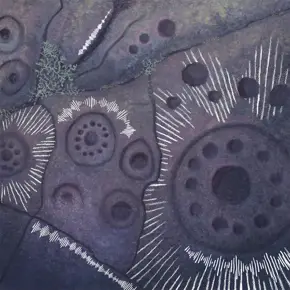
    Pale blue art depiction of cave art with green foliage

    This illustration by artist and archaeologist Lizzie Robertson of the rock art at Ormaig in Argyll explores the experience of carving the rock, using this description of carving his own cupmark by experimental archaeologist Hugo Anderson-Whymark:

    “The motion of the hammer stone is fast and constant, and the repetitive rhythm of pecking becomes more hypnotic and meditative with time. The sound echoes around and curiously appears to come from elsewhere, perhaps the trees but certainly not the rock.”

    Lizzie imagined this rhythmic pecking as sound waves dancing in the air above the carvings. She also used photographs and the visualisations resulting from laser scanning to depict the motifs of cupmarks, cup and rings and rosettes as they were originally created.

    An ecological narrative
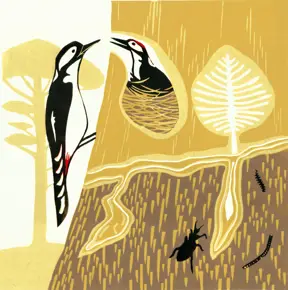
    A yellow art depiction of two wood peckers and a tree

    The only sound being pecked out in these woods today is that of the great spotted woodpecker. Known as drumming, the sound is made by the woodpeckers hammering their bills against deadwood up to twenty times over two or three seconds. The sound resonates throughout the forest and carries over large distances. This drumming acts as a message to other woodpeckers that "this territory is occupied."

    Great spotted woodpeckers excavate nest holes in trees, with standing dead trees being their favourite site. These standing dead trees are known as snags by our foresters. As the bark peels from these snags, the amazing galleries made by beetle larvae eating the wood are revealed. All of this ecology is perfectly captured in this linocut print by artist Liz Myhill.

    Could you be a rock artist?

    The original rock artists lived thousands of years ago. Today, we are looking for new original rock artists – but this time, the original means creative! We’re looking for young artists, aspiring archaeologists and eager ecologists to illustrate the archaeology of ancient rock art in the context of the ecology of the natural world. Think about what could have inspired symbols like the cup and ring – in the sky, on the land, in the water or in the patterns formed by our flora and fauna. We are looking for pictures placing the abstract designs of rock art in the natural world to illustrate our new rock-art-ology.

    Two lucky rock artists (or rock-art-ologists) will be turned into a cartoon illustration and make their own appearance in the distant past. Artist Alex Leonard will professionally reproduce the best design.

    Matt says:

    We don’t mind if it’s drawn, painted, or a photograph put together from things found in the woods, such as sticks and stones – even feathers and bones. It just needs to show symbols from rock art as they could be found in nature. So get creative!”

    Anyone between the ages of 8 and 13 who reckons they could be a new original rock artist should send a photograph of their artwork to matt.ritchie@forestryandland.gov.scot by the 1st of June.

    Our woodland heritage booklets are both reference material and learning resources. They use a popular communication style and bold design to align an archaeological and ecological ethos with a more subtle message of stewardship and responsibility. They are intended to share and shape values across a wide readership while preparing the practitioner with information and ideas for their learners. Read our blog, Mesolithic Map Makers to find out about a previous art competition.

    Find out more

    Latest from FLS

    1. 12 Jan 2026

      Lesley's article

    2. 03 Oct 2025

      Scotland's Climate Week 2025: Working together in the Angus Glens

    3. 29 Sep 2025

      Scotland's Climate Week 2025: Working with partners to support beaver populations

    4. 19 Sep 2025

      Martens on the Move at Kirroughtree

    5. 20 Aug 2025

      Protecting endangered apple trees through teamwork

    Share this article

    • Share on Facebook
    • Share on X
    • Share on LinkedIn

    Feedback

    There is a problem

    Feedback

    Thank you for your feedback

    User feedback form


    Your feedback helps us to improve this website. Do not give any personal information because we cannot reply to you directly.


    Your feedback helps us improve this website. Do not provide any personal information here. If you need to get in touch with a query, please contact us.


    Your feedback helps us improve this website. Do not provide any personal information here. If you need to get in touch with a query, please contact us.

    Forestry and Land Scotland Logo

    Follow us on

    • Forestry and Land Scotland on Facebook
    • Forestry and Land Scotland on Twitter
    • Forestry and Land Scotland on Instagram
    • Forestry and Land Scotland on LinkedIn

    Utilities

    1. Accessibility
    2. Cookies
    3. Privacy Notice
    4. Terms and Conditions
    5. Freedom of Information
    6. Modern Slavery Statement

    Quick links

    1. Media Centre
    Forest Stewardship Council, the mark of responsible forestry Programme for the Endorsement of Forest Certification, PEFC
    © Crown Copyright
    Forests and land that Scotland can be proud of Link to gov.scot gov.scot