Forestry and Land Scotland Logo
  1. Visit
      1. Find a forest
      2. Explore forest parks
    1. Accessible forests
    2. Stay the night
      1. Waymarked trails
      2. Cycling
      3. Mountain biking
      4. Photography
      5. Orienteering
      6. Camping
      7. Treetop adventure
      8. Water sports
      9. Horse riding
      1. Things to see
      2. Trees
      3. Wildlife
      4. Heritage
      5. Things to see in Winter
    3. Plan a visit with a group
    4. Visiting safely
    5. Parking
    Forest map

    Search for a forest by map

    Forests & trails information and closures

    An overview of all closures and high risk warnings on trails.

    Stay the night

    Park overnight in selected forest car parks as part of our motorhome scheme.

  2. About us
      1. Who we are
      2. Our mission and vision
      3. Leadership team
      4. Our values
      1. Careers
      2. Current Vacancies
      3. What we offer
      4. Candidate information
      5. A day in the life
      6. Apprenticeships
    1. Key documents
    2. Our impact
    3. Our approach to Gaelic
    Current Vacancies

    Some text

  3. What we do
      1. Taking Climate Action
      2. The climate emergency
      3. Forest resilience
      4. Peatland restoration
      5. Carbon offsetting
      6. Biodiversity
      7. Renewable energy
      1. Managing the land
      2. Planning our land management
      3. Our sustainable forestry
      4. Our tree nursery
      1. Conservation
      2. Habitat conservation
      3. Wildlife conservation
      4. Historic environment conservation
    1. Supporting outdoor exploration
    2. Working with communities
    3. Our projects
  4. Living and Working
      1. For businesses
      2. Timber sales
      3. Procurements and tenders
      4. Business opportunities
      5. Farming opportunities
      6. Venison sales
      7. Firewood sales
      1. For communities
      2. Transfer land and buildings to your community
      3. Land management plan consultations
      1. Permissions and Permits
      1. Learning and Education
      2. Outdoor learning
      3. Activity sheets
    1. Buy Land or Buildings
    Land management plan consultations

    Text here

    Current job opportunities

    Text here

  5. Get involved
    1. Have your say on consultations
    2. Hold an event
    3. Apply for a community asset transfer (CAT)
    4. Arrange a visit
    5. Work with us
  6. News
  7. Contact
Suggested links
    1. Home
    2. News
    31 December 2021 4 minutes

    Riparian zones

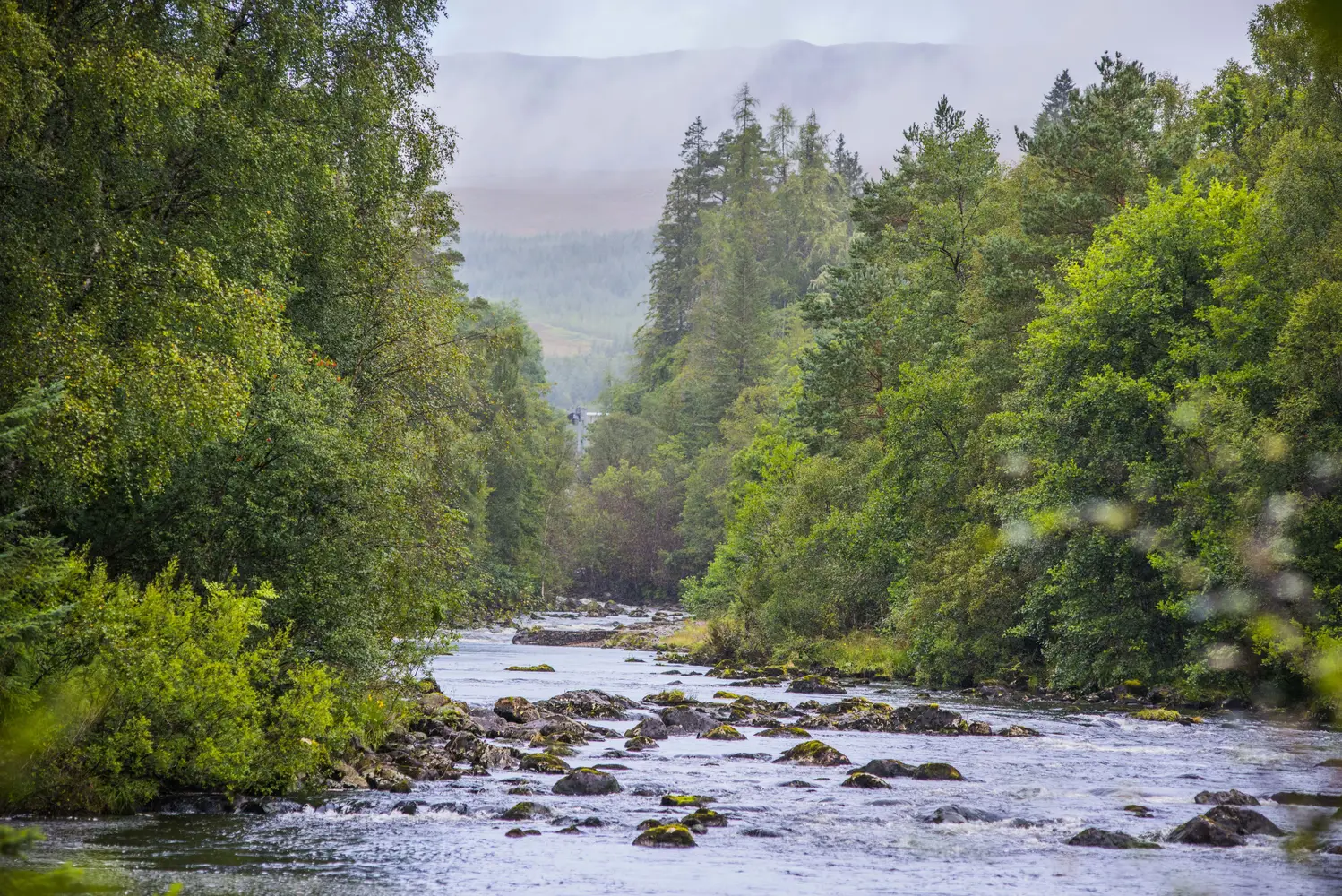
    View along the River Garry, flanked by trees and greenery, Glengarry, near Invergarry

    A riparian zone is the area of land along a river or burn. We plant native broadleaf trees along these zones to help with climate change and biodiversity, creating robust wildlife corridors that are not felled for timber.

    These important areas are fundamental for a range of projects boosting resilience in our forests. Some of their benefits include:

    Shade: broadleaf trees offer just the right amount of shade over the water. This not only provides shade for the fish but also helps prevent water temperatures from increasing. The rise in water temperatures across Scotland is expected to negatively affect freshwater fish, such as salmon, as they spawn in our rivers.

    Nutrients: when broadleaf trees shed their leaves in autumn, some of them will end up in the water. These leaves will eventually decompose, adding essential nutrients into the water's soils, helping to support richer aquatic invertebrate communities. Our rivers and burns typically lack nutrients, so this is key to having healthy water systems.

    Bank stabilisation: tree roots can help provide structure to riverbanks, helping prevent erosion.

    Wildlife corridor: riparian zones not only provide better spawning habitats for freshwater fish, but also provide semi-natural areas where other wildlife such as otters and osprey can thrive. Following the length of the river or burn, these extended linear areas provide protected routes for animals to travel along.

    Carbon: while these long lived woodlands can be slower at capturing carbon, they will become effective carbon stores over time, as both trees and the more stable soils grow.

    Biodiversity: riparian zones provide networks for a range of species through a natural travel corridor. They also provide rich habitats, great for plants, fungi, mosses and lichens.

    Flooding: though conifers are the real flood management powerhouses, natural broadleaf woodland around rivers will also play its part. Trees absorb water through their leaves, roots, and bark and create grooves in the ground that slows water flow.
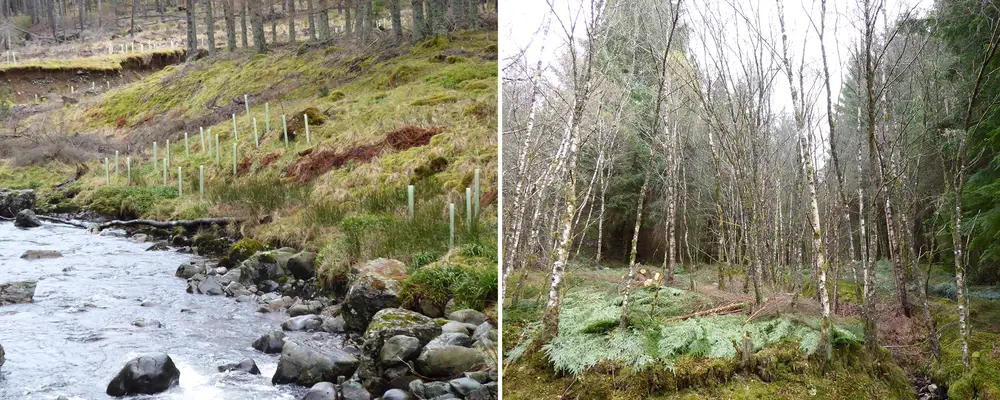
    riparian zone restoration work in autumn

    Riparian zones and climate change

    Riparian zones can help in several ways. The additional trees reduce flooding downstream and help improve water quality by slowing the flow rate and filtering water through vegetation, such as mosses and grass. 

    Additional trees mean that we are capturing more carbon, helping to reduce global warming. The natural wildlife corridor and extra nutrients in the water will help with the biodiversity crisis by providing habitats for a range of species. Overall the riparian zones are helping to create large, resilient linear networks of land spanning across landscapes.

    Learn more about the benefits of riparian zones on our Future Forest podcast

    Listen now: Future Forest Podcast

    How we restore riparian zones

    Riparian restoration consists of planting a range of native broadleaf trees such as oak, alder, birch, aspen, hazel and bird cherry along the rivers and burns that run through the land we manage.

    We have been doing this for decades across Scotland and, in the past five years, a large-scale riparian project has started in our eastern forests. The project in the East of Scotland involves planting and protecting thousands of native trees, which will act as a seed source for future natural regeneration. The goal is to create a connected semi-natural woodland that runs the entire length of the watercourse.

    Sometimes the restoration involves removing non-native and conifer trees too close to the water. Conifer trees often provide too much shade, reducing wildlife activity under the surface. In contrast, the carefully placed (or located) native broadleaves offer the right amount of shade to prevent water temperatures from increasing while delivering essential nutrients to the water.

    Other riparian projects:
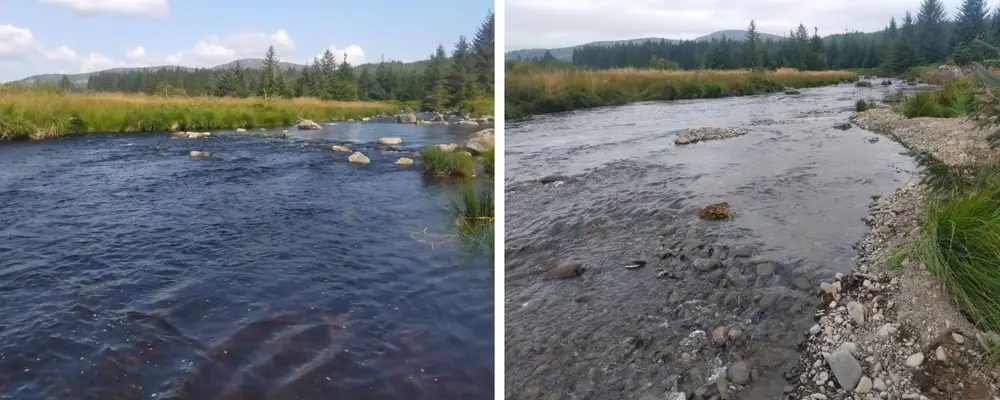
    before and after image of riparian restoration

    Black Water of Dee

    This partner run project is the first of its kind in Scotland. The goal is to repair the overall habitat of salmon and other freshwater fish along the Black Water of Dee through the restoration of a large riparian area. 

    This involves removing conifer trees from the riverbanks and adding gravel to build up the spawning habitats.

    Learn more about the Black Water of Dee project
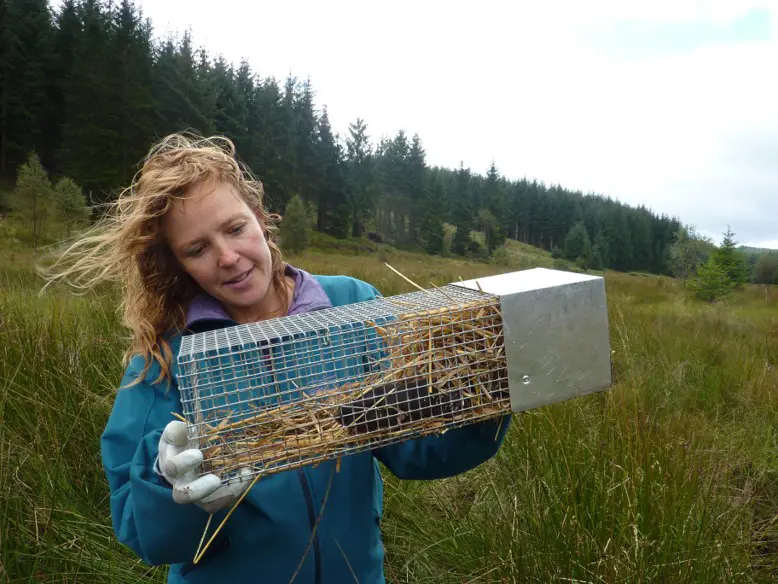
    Staff member holding a water vole in a live trap

    Water Voles in the Trossachs

    We helped relocate water voles to the Queen Elizabeth Forest Park in the Trossachs. These little eco-system engineers can positively affect the biodiversity around riparian zones through burrowing and grazing.  

    Since initially releasing 1000 water voles in 2008, the population has grown and now covers an area of 100km².

    Learn more about the water vole project

    Latest from FLS

    1. 12 Jan 2026

      Lesley's article

    2. 03 Oct 2025

      Scotland's Climate Week 2025: Working together in the Angus Glens

    3. 29 Sep 2025

      Scotland's Climate Week 2025: Working with partners to support beaver populations

    4. 19 Sep 2025

      Martens on the Move at Kirroughtree

    5. 20 Aug 2025

      Protecting endangered apple trees through teamwork

    Share this article

    • Share on Facebook
    • Share on X
    • Share on LinkedIn

    Feedback

    There is a problem

    Feedback

    Thank you for your feedback

    User feedback form


    Your feedback helps us to improve this website. Do not give any personal information because we cannot reply to you directly.


    Your feedback helps us improve this website. Do not provide any personal information here. If you need to get in touch with a query, please contact us.


    Your feedback helps us improve this website. Do not provide any personal information here. If you need to get in touch with a query, please contact us.

    Forestry and Land Scotland Logo

    Follow us on

    • Forestry and Land Scotland on Facebook
    • Forestry and Land Scotland on Twitter
    • Forestry and Land Scotland on Instagram
    • Forestry and Land Scotland on LinkedIn

    Utilities

    1. Accessibility
    2. Cookies
    3. Privacy Notice
    4. Terms and Conditions
    5. Freedom of Information
    6. Modern Slavery Statement

    Quick links

    1. Media Centre
    Forest Stewardship Council, the mark of responsible forestry Programme for the Endorsement of Forest Certification, PEFC
    © Crown Copyright
    Forests and land that Scotland can be proud of Link to gov.scot gov.scot