
Restoring, expanding and protecting Scotland’s rainforest zone
 You might think our work is all about timber production, but that’s only part of our story. We also develop renewable energy schemes, conserve wildlife and protect and restore habitats.
This Scotland's Climate Week, we’re looking at some of the important work our teams are doing to protect and expand Scotland’s native woodlands. We know that these habitats, particularly our incredibly precious – and rare – temperate rainforests, play an important role in helping to tackle the twin crises of the climate emergency and biodiversity loss. That’s why we work hard to balance Scotland’s need for sustainable timber with our commitment to these sites.
Achnashellach
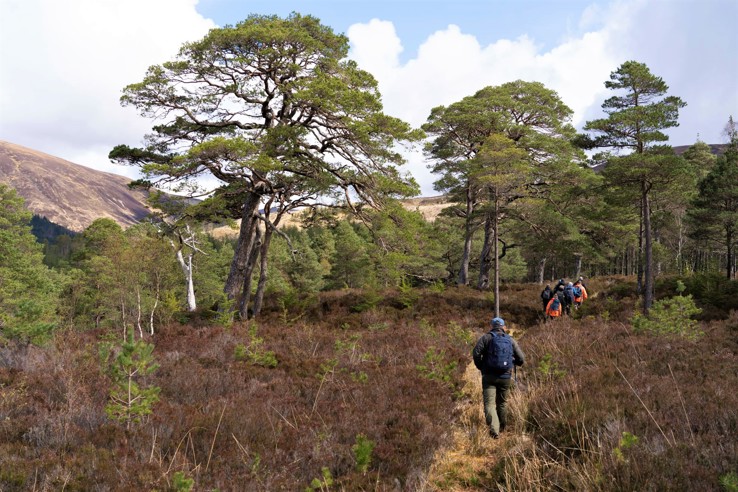
On the lower slopes of the mountains at Achnashellach, there are signs that native woodland is returning and expanding. Young Scots pine and birch are beginning to cover once clear ground. They will be among the native species eventually linking remaining pieces of ancient and native woodlands in Scotland’s temperate rainforest zone.
There are also signs left by the harvesting of commercial conifers. As part of our long-running project to restore the Caledonian pine woodland here, a section of over-mature conifers at Allt na Choinais was removed in 2019.
Growing on the difficult and steep slope and isolated on the wrong side of a deep, inaccessible gorge, getting them off the hill was a challenge. A skyline system (using wire ropes and a winch) proved perfect for moving the whole trees (at two tonnes a time) over 650m to a processor 150m below the skyline rope.
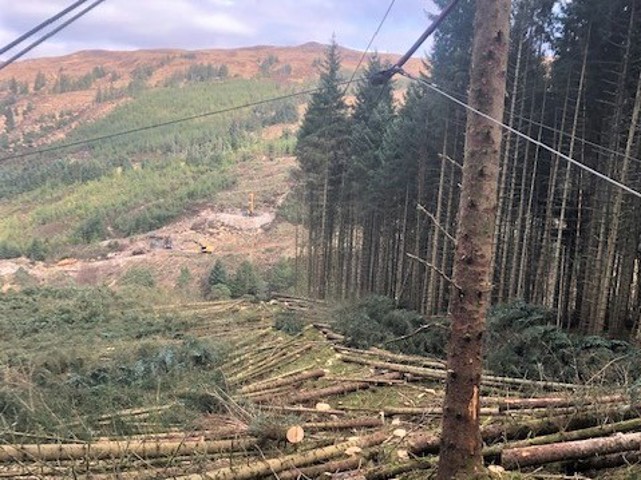
Harvesting and moving mature conifers from hard-to-access sites planted nearly 100 years ago is just one of the challenges we face when restoring native woodland.
The nibbled branches on several young trees at this site highlights another major issue for the regeneration of native forests. High density deer populations are widespread across the hills and glens of Wester Ross. Without management, they can damage and even kill young trees.
Slattadale Forest
On the shores of Loch Maree – looking out to the old Caledonian pine clad island of Eilean Ruairidh Mòr – our teams are restructuring the entire Slattadale Forest area. From a mainly productive timber resource of mostly non-native conifers, they’re creating a naturalised mosaic of native woodland, riparian (riverside) and open ground habitats.
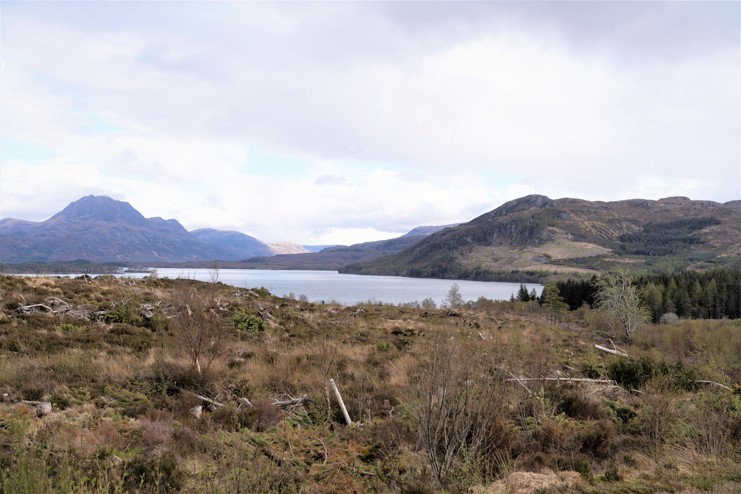 Work here, after felling, includes the careful removal of invasive non-native species like Rhododendron ponticum and any regeneration of previous commercial conifers.
Supporting Scotland’s rainforest
Scotland’s west coast is home to the last remains of our temperate rainforest, with ancient oak, ash, birch, hazel and Scots pine. Here, you’ll also find rare and fascinating mosses and liverworts, lichens, fungi and ferns.
The surviving pockets of Caledonian pine forest like that at Achnashellach are a key part of ongoing landscape-scale work across the rainforest zone to restore existing woodlands.
Because we’re working at landscape-scale, we try to make the changes gradually to avoid sudden shifts in humidity and give the species that live there time to respond and become more robust.
Our work is part of the collaborative efforts of 25 organisations known as the Alliance for Scotland’s Rainforest. Together, we’re enabling existing fragments of woodland to expand and re-connect. The aim is to create more native woodlands around and near existing rainforest sites on the west coast and support a larger, more resilient national rainforest resource.
Scotland’s rainforest is one of our most precious habitats. It’s as important as tropical rainforest but even rarer. Balancing the need for commercial forestry with the conservation and expansion of this biodiverse ecosystem forms part of our forestry operations today.
Why we still need commercial forestry
Currently, the UK is the second largest net importer of forest products in the world (Forest Research, ‘Forestry Facts & Figures 2024’). That's why our work to produce sustainable FSC certified timber for Scotland is so important.
For one, it helps to reduce emissions caused by transporting goods from other parts of the world. It also means we can be confident of where the timber has come from and how it was harvested.
The timber industry is vital to the Scottish economy. Forestry and timber processing accounts for £878 million of Gross Value Added (GVA) every year – that’s even more than the fishing industry. It also provides more than 30,000 jobs across the wood production, forest management, haulage and processing sectors – often in rural areas. Timber from Scotland’s national forests is used for house building, fencing, paper and bio-fuel.
The UK also has one of the lowest proportions of forest cover in Europe, at just 13% (Forest Research, ‘Forestry Facts & Figures 2024’). So, while it’s clear that we in the UK use a lot of timber, we don't currently produce nearly enough ourselves, and we still have far less woodland cover than other nearby countries.
Basically, we need to grow more trees. We need more productive forests to supply sustainable materials for the future, and we need more native and mixed forests for nature. Balancing these key objectives is central to our work.
From forest planners and managers, to ecologists, engineers and our wildlife rangers, our staff are committed to achieving – in the long term – a positive balance between ancient woodland sites and new areas of native woodland along with the need for commercial forests.