Our peatland team visit Irish blanket bog restoration sites
In March, our peatland team visited sites managed by Coillte Nature, a not-for-profit branch of the Irish semi-state forestry company - Coillte, for a knowledge-sharing visit about restoration.
Ian McKee, our Peatland Technical Advisor, and Tim Cockerill, a Peatland Restoration Forester based in North Highland, have been involved with the restoration of thousands of hectares of bog across Scotland.
About 900 hectares of peatland was restored last year across the national forests and land, and our teams are gearing up to restore 3,000 hectares annually from 2025 onwards.
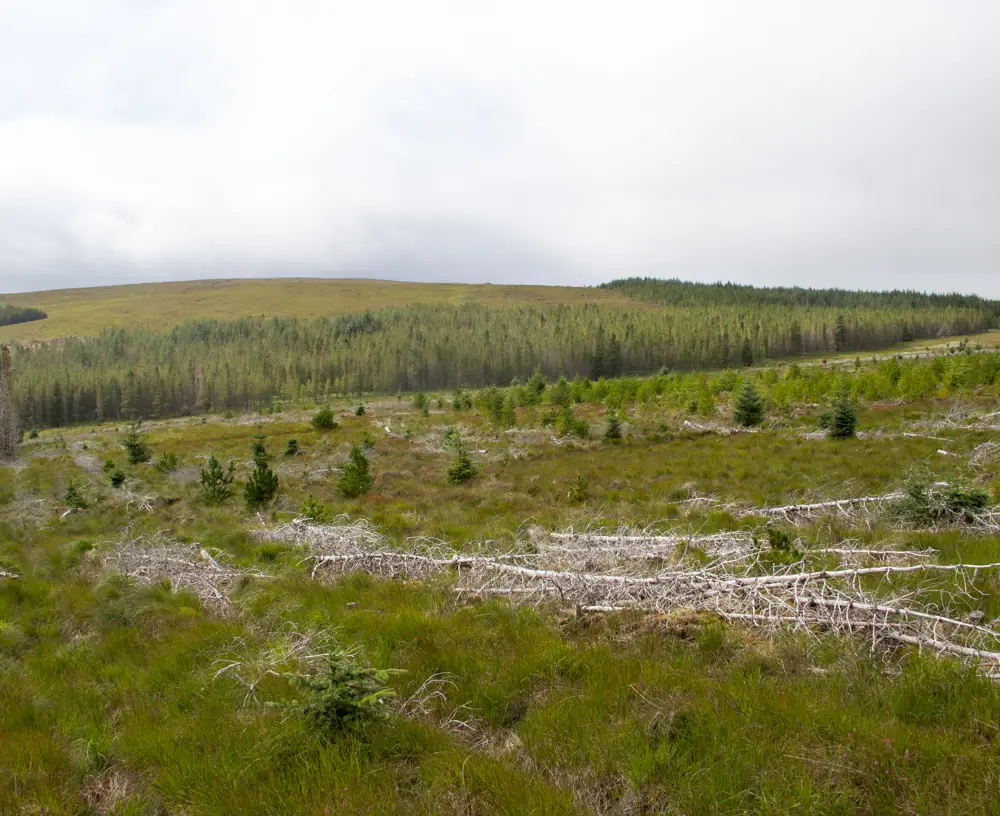
Last May, Ian and Tim led the Coillte Nature Team on a field trip of multiple ‘forest to bog’ restoration sites across Scotland to share the approaches being used there on a large scale. This involves restoring peatland sites which were planted over forty years ago with a crop of pine or spruce.
Healthy peatlands are valuable biodiversity sites supporting many species found nowhere else, as well as being important for capturing and storing atmospheric carbon. They also act as a natural storage and filtration system for rainwater before it flows into our watercourses, which can reduce drinking water treatment costs as well as reducing flooding.
Blanket bog is a relatively rare habitat elsewhere in Europe, with Ireland and Scotland having a large proportion of the habitat found in Europe. However, most of our blanket bog habitats are in poor condition due to human activity and as a result, are not functioning as they should. Thus, rather than absorbing carbon from the atmosphere, they are releasing carbon which has been stored in the peat for thousands of years.
Ian hails from County Antrim and is familiar with many of the peatlands of Ireland, having written the first ever ‘forest to bog’ peatland restoration plan in County Tyrone in 2005 with the Northern Ireland Forest Service.
During the tour, the group inspected several blanket bog sites in County Mayo which were restored between 15 and 20 years ago to see what could be learned as Coillte Nature takes on new large-scale blanket bog restoration projects under the Wild Western Peatlands project.

Our staff along with the Coillte team inspecting a peat dam on a blanket bog restored in the early 2000s
Bog restoration techniques have improved since these first blanket bog sites were restored. Our understanding of the importance of restoring our bogs from a carbon perspective has also grown.
The aim of bog restoration is to restore the natural functions of the bog by creating the conditions for water-loving mosses to grow which form the basis of a blanket bog. In simple terms, the bog should hold water as it would naturally, which cannot happen if it is artificially drained. For this reason, damming drains is one of the key actions in bog restoration work.
One of the newer techniques we’ve been developing is called ‘stump flipping and ground smoothing’ and a technique Coillte is interested in using at Derryclare a large-scale pilot restoration site in Connemara.
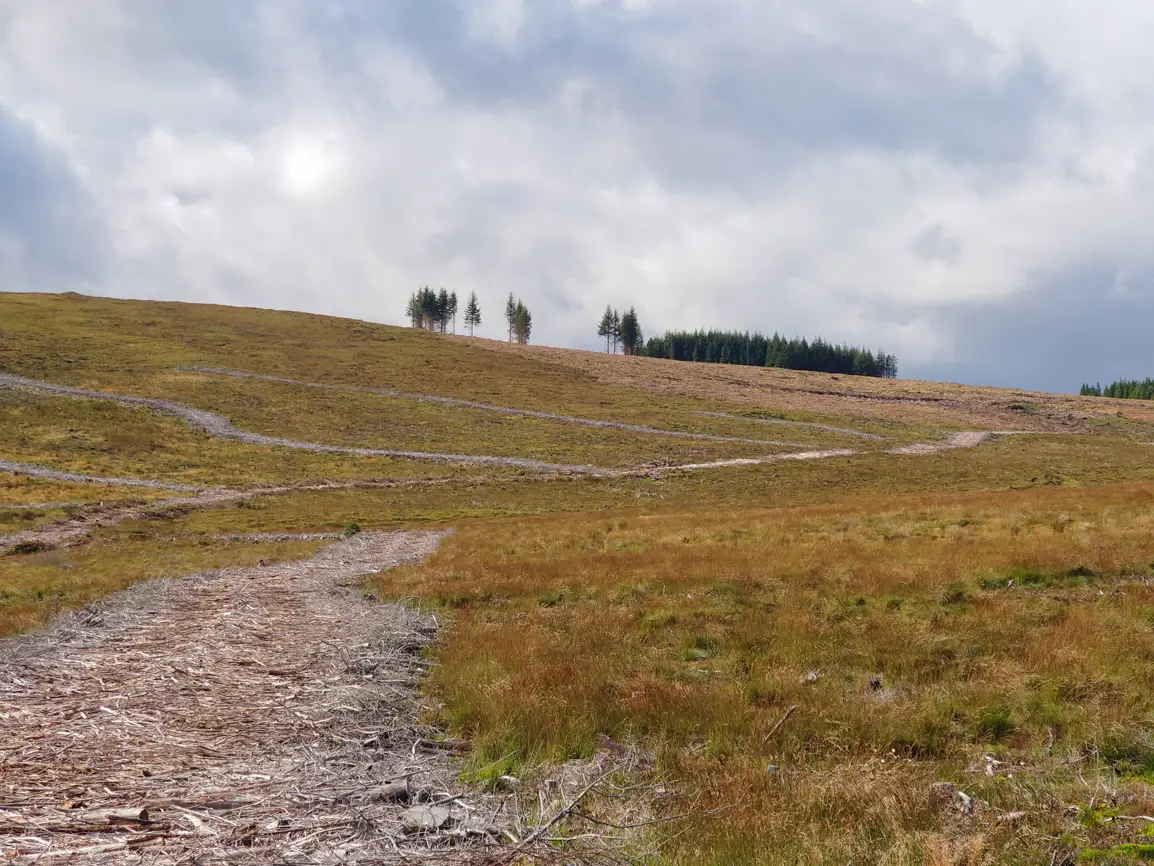
Craggie in September 2022. The site has now benefitted from 3 growing seasons and sphagnum mosses and other desirable species have grown on the slopes.
When these peatlands were planted with conifers, the land was ploughed, leaving rows of ridges and furrows in the bog. This presents a barrier to quick and effective restoration of the functioning of the blanket bog and its vegetation communities, as the higher parts remain too dry. Once trees have been removed from a site, the ‘stump flipping and ground smoothing’ involves pushing the remaining tree stumps and peaty ridge into the lower furrows, creating level ground akin to that found on unmodified peatlands. This allows the ground to rewet more evenly and allows the bog to recover quicker, as well as giving better long-term results as there are no longer sections left to dry out above the water table (which would also act as a carbon emitter).
Following the visit to the site, Ian reported that “the Derryclare restoration site reminded me a lot of the projects we have carried out in the North of Scotland. The peat characteristics, modifications, slopes and hydrology are all very similar. My conclusion is that the current restoration methods will restore this site very effectively, and I look forward to returning in the future to see the progress made by Coillte”.
Tim Cockerill also noted the similarities and was equally optimistic that the restoration techniques that we currently employ will work well for the Coillte team.
Tim said, “We have been delivering landscape scale peatland restoration in the North of Scotland since 2015 and this year are set to restore another 900ha. As part of this work we have developed new techniques that allow us to harvest forestry plantations on peatland sites without damaging the peat and we are continually developing and refining our rewetting methods. As the photographs below hopefully show, these techniques are resulting in rapid and successfully restoration of these previously afforested sites with peat forming plants such as cotton grass and sphagnum mosses rapidly recolonising these sites.
We’ve been working with various other groups to promote peatland restoration, how we are doing it and explaining how people might get into peatland restoration to promote the industry and get more people doing this important work.
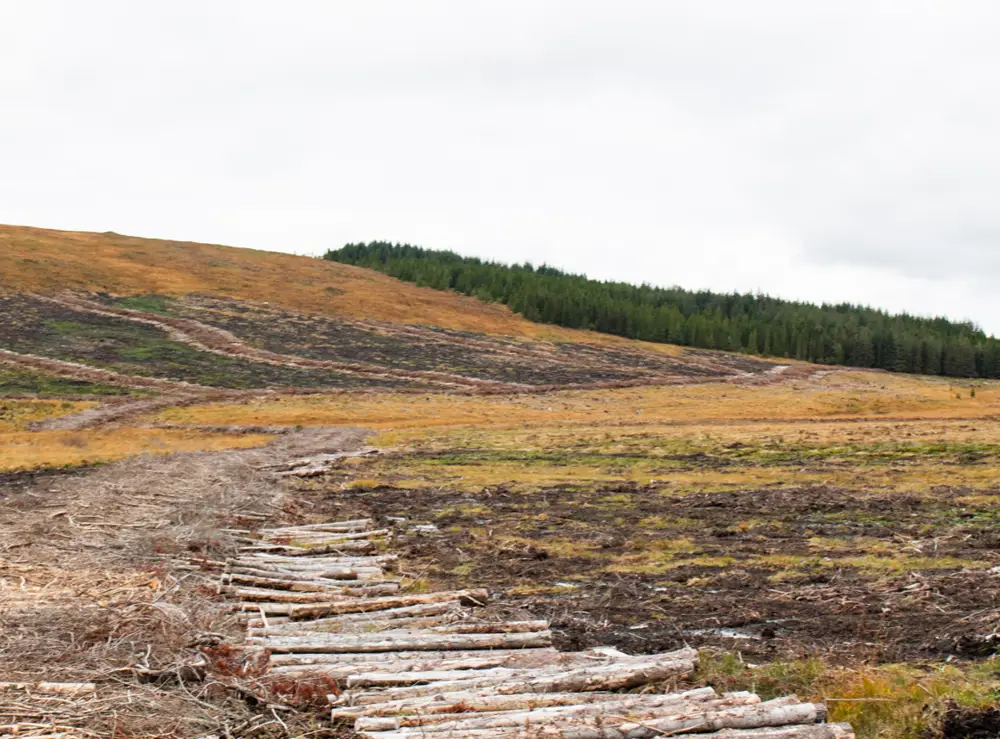
Bog restoration in Craggie in West Sutherland, Scotland October 2020 after after tree harvesting and ground smoothing with one growing season of recovery. The trunks are laid out as a ‘brash mat’ for driving machinery over to reduce compacting the peat.