Forestry and Land Scotland Logo
  1. Visit
      1. Find a forest
      2. Explore forest parks
    1. Accessible forests
    2. Stay the night
      1. Waymarked trails
      2. Cycling
      3. Mountain biking
      4. Photography
      5. Orienteering
      6. Camping
      7. Treetop adventure
      8. Water sports
      9. Horse riding
      1. Things to see
      2. Trees
      3. Wildlife
      4. Heritage
      5. Things to see in Winter
    3. Plan a visit with a group
    4. Visiting safely
    5. Parking
    Forest map

    Search for a forest by map

    Forests & trails information and closures

    An overview of all closures and high risk warnings on trails.

    Stay the night

    Park overnight in selected forest car parks as part of our motorhome scheme.

  2. About us
      1. Who we are
      2. Our mission and vision
      3. Leadership team
      4. Our values
      1. Careers
      2. Current Vacancies
      3. What we offer
      4. Candidate information
      5. A day in the life
      6. Apprenticeships
    1. Key documents
    2. Our impact
    3. Our approach to Gaelic
    Current Vacancies

    Some text

  3. What we do
      1. Taking Climate Action
      2. The climate emergency
      3. Forest resilience
      4. Peatland restoration
      5. Carbon offsetting
      6. Biodiversity
      7. Renewable energy
      1. Managing the land
      2. Planning our land management
      3. Our sustainable forestry
      4. Our tree nursery
      1. Conservation
      2. Habitat conservation
      3. Wildlife conservation
      4. Historic environment conservation
    1. Supporting outdoor exploration
    2. Working with communities
    3. Our projects
  4. Living and Working
      1. For businesses
      2. Timber sales
      3. Procurements and tenders
      4. Business opportunities
      5. Farming opportunities
      6. Venison sales
      7. Firewood sales
      1. For communities
      2. Transfer land and buildings to your community
      3. Land management plan consultations
      1. Permissions and Permits
      1. Learning and Education
      2. Outdoor learning
      3. Activity sheets
    1. Buy Land or Buildings
    Land management plan consultations

    Text here

    Current job opportunities

    Text here

  5. Get involved
    1. Have your say on consultations
    2. Hold an event
    3. Apply for a community asset transfer (CAT)
    4. Arrange a visit
    5. Work with us
  6. News
  7. Contact
Suggested links
    1. Home
    2. News
    08 November 2021 5 minutes

    New project helping to support fish populations in Galloway Forest Park

    This partner-run project is thought to be the first of its kind in Scotland. Through a series of environmental restoration tasks, the project's goal is to restore the Black Water of Dee to be more favourable for salmon and trout.
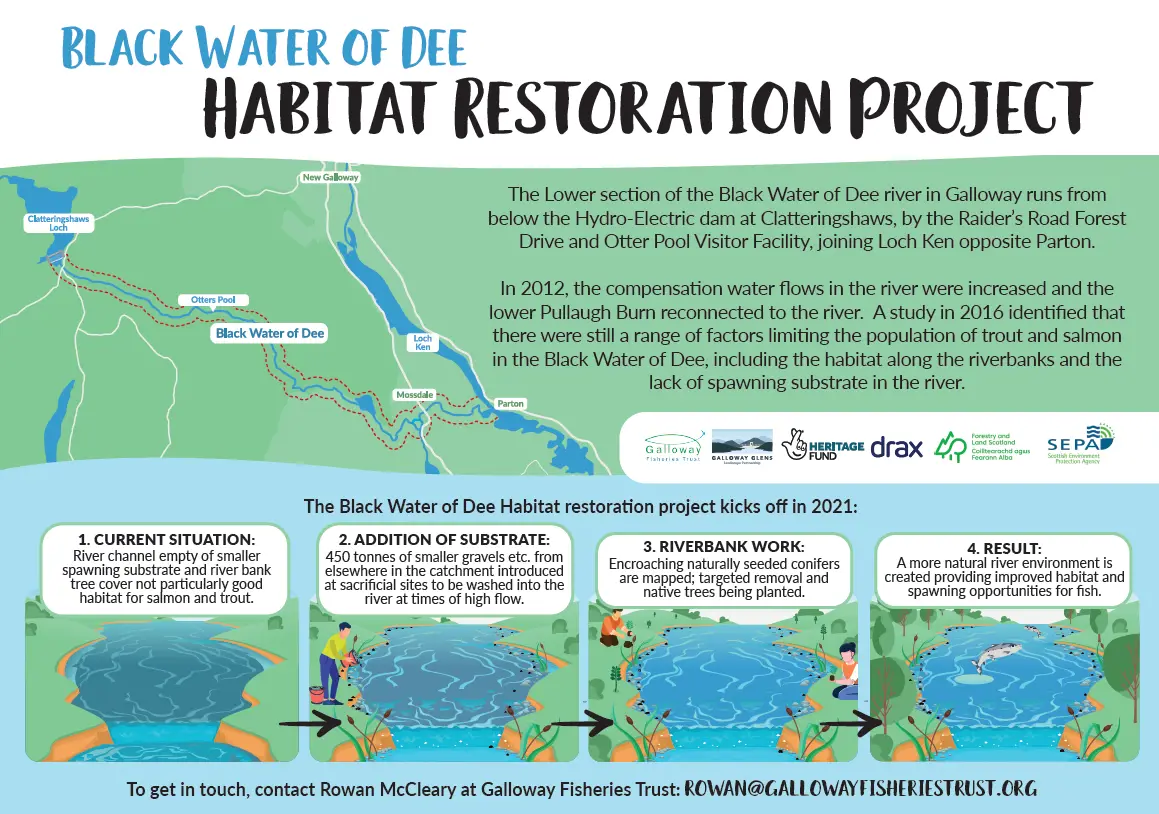
    A graphic showing riverbank restoration

    Infographic text
    Black Water of Dee Restoration Project. 

    The lower secton of the Black Water of Dee river in Galloway runs from below the Hydro-Electric dam at Clatteringshaws, by the Raider's Road Forest Drive and Otter Pool Visitor Facility, joining Loch Ken opposite Parton. 

    In 2012, the compensation water flows in the river were increased and the lower Pullaugh Burn reconnected to the river. A study in 2016 identified that there were still a range of factors limiting the population of trout and salmon in the Black Water of Dee, including the habitat along the riverbanks and the lack of spawning substrate in the river.

    The Black Water of Dee Habitat restoration project kicks off in 2021:

    Current situation: river channel empty of smaller spawning substrate and river bank tree cover not particularly good habitat for salmon and trout. 
    Addition of substrate: 450 tonnes of smaller gravels etc. from elsewhere in the catchment introduced at sacrificial sites to be washed into the river at times of high flow. 
    Riverbank work: encroaching naturally seeded conifers are mapped; targeted removal and native trees being planted.
    Result: a more natural river environment is created providing improved habitat and spawning opportunities for fish.

    To get in touch, contact Rowan McCleary at Galloway Fisheries Trust: rowan@gallowayfisheriestrust.org 
     

    The project started after a study showed the site has great potential for migratory fish, such as salmon and trout. However, Galloway Fisheries Trust (the founders of the project) found very few fish present while surveying the water. 

    Some of the issues noted include the creation of a hydroelectric dam further upstream, which is washing away gravel beds needed for spawning fish. Non-native conifer trees are also growing too close to the riverbank. This causes a few problems. The first is that conifers don't provide the same nutrients to the water as broadleaves do. The second issue is they can cast too much shade and cause bankside erosion. 

    These stressors are impacting the population of both these important species, and lead to this exciting partnership project formed along the Black Water of Dee.
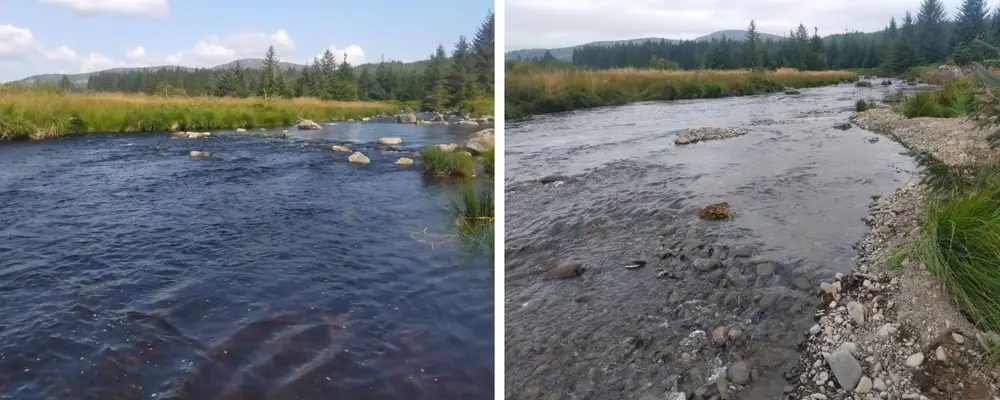
     Before and after image of a riverbank during restoration
    Here we see before and after we added 140 tonnes of gravel to the river. The gravel is moved and sorted by the current, creating a range of habitats from spawning beds to places for juvenile fish to live.

    How the habitat is being restored  

    There are many things we can do to restore freshwater fish populations in Scotland. Even small changes can really make a huge difference in creating better habitats for aquatic life, for example planting broadleaf trees provides dappled shade, nutrients and protects the riverbanks.

    This project is focusing on three areas of restoration;  

    • Building up the riverbed: adding additional gravel (around 450 tonnes) to the site will help increase the available spawning habitat for the fish.
    • Removing conifers from the riverbank: this will help lower the acidification level in the river and help create better water quality for the salmon and their eggs.
    • Planting native trees along the riverbank: planting native broadleaf trees along the riverbank will provide dappled shade (which will help keep the water cool) and provide nutrients back into the water when the leaves fall. 
     

    Why are salmon important

    “Salmon are nationally one of our priority species for conservation.

    The project has taken many years of hard planning by all the partners. As the land owner, being given the opportunity to collaborate in the Black Water of Dee project has helped us to better understand the local issues affecting salmon populations. This is key for the survival of the species.  

    In the long term not only will this project help the local salmon population but it has also created a stepping stone for future restoration projects of this scale on a national level.”

    Kim Kirkbride, Environment Forester at Forestry & Land Scotland
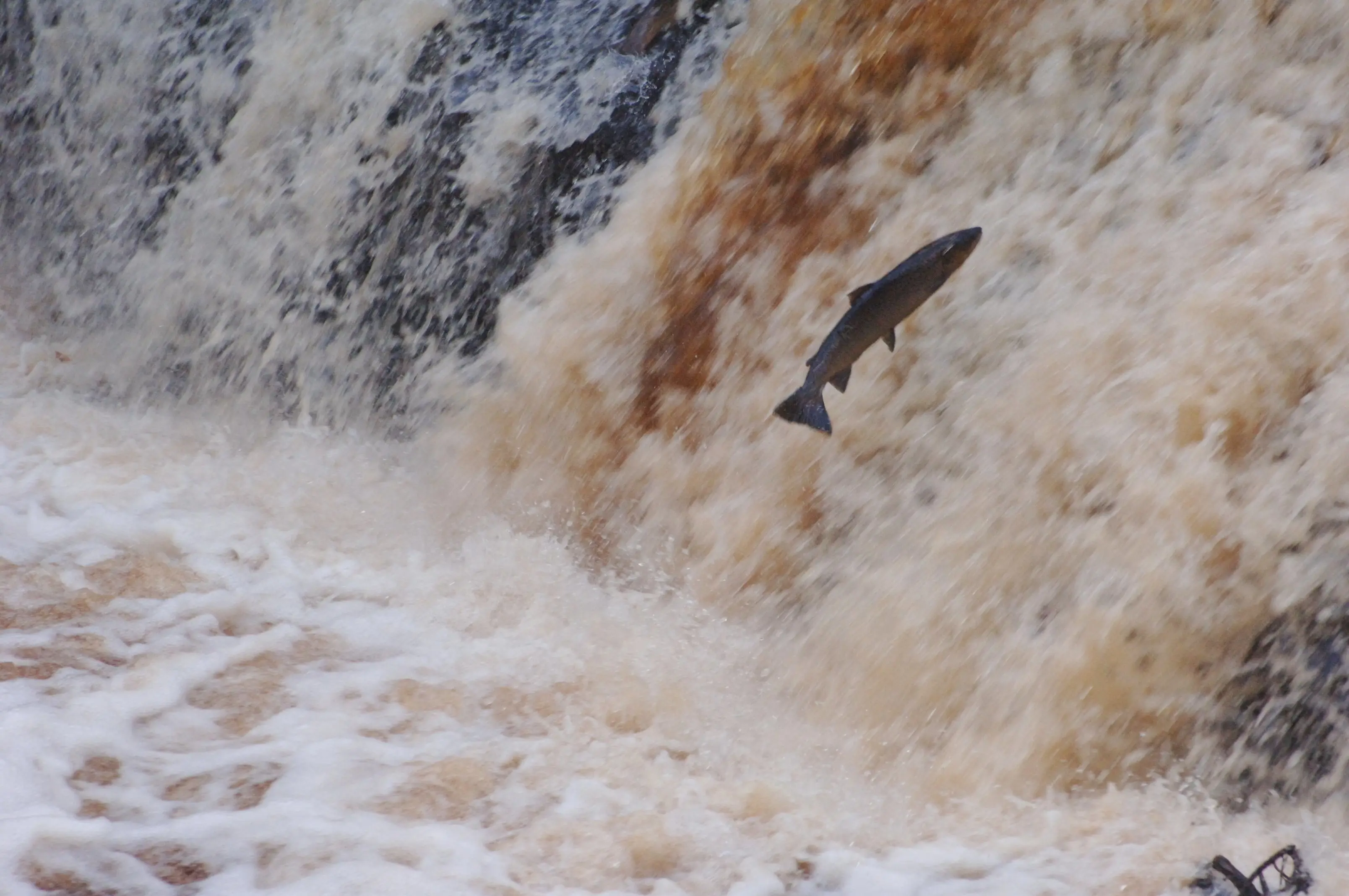
    A salmon jumping during spawning

    Having healthy populations of salmon is important to rivers and burns because they help move nutrients between the sea and the freshwater ecosystem where they spawn. Often these smaller bodies of water have lower levels of nutrients, so this can really benefit the overall biodiversity.   

    We’re now seeing higher water temperatures in Scotland, most likely due to climate change and a lack of broadleaf trees and scrub along the riverbanks. Research shows that it’s likely getting too warm for the salmon eggs and young salmon to survive in.  Planting native trees along the riverbanks provides shades the water, reducing the increasing water temperatures during summer and making the habitat better for the young salmon.


     Learn more about salmon in Scotland
     

    Where you can see the project in action

    The Black Water of Dee is the largest tributary of the Kirkcudbrightshire Dee, whose lower end flows through the Galloway Forest Park along the Raiders Forest Drive.
     
    Raider's Forest Drive 


    Latest from FLS

    1. 12 Jan 2026

      Lesley's article

    2. 03 Oct 2025

      Scotland's Climate Week 2025: Working together in the Angus Glens

    3. 29 Sep 2025

      Scotland's Climate Week 2025: Working with partners to support beaver populations

    4. 19 Sep 2025

      Martens on the Move at Kirroughtree

    5. 20 Aug 2025

      Protecting endangered apple trees through teamwork

    Share this article

    • Share on Facebook
    • Share on X
    • Share on LinkedIn

    Feedback

    There is a problem

    Feedback

    Thank you for your feedback

    User feedback form


    Your feedback helps us to improve this website. Do not give any personal information because we cannot reply to you directly.


    Your feedback helps us improve this website. Do not provide any personal information here. If you need to get in touch with a query, please contact us.


    Your feedback helps us improve this website. Do not provide any personal information here. If you need to get in touch with a query, please contact us.

    Forestry and Land Scotland Logo

    Follow us on

    • Forestry and Land Scotland on Facebook
    • Forestry and Land Scotland on Twitter
    • Forestry and Land Scotland on Instagram
    • Forestry and Land Scotland on LinkedIn

    Utilities

    1. Accessibility
    2. Cookies
    3. Privacy Notice
    4. Terms and Conditions
    5. Freedom of Information
    6. Modern Slavery Statement

    Quick links

    1. Media Centre
    Forest Stewardship Council, the mark of responsible forestry Programme for the Endorsement of Forest Certification, PEFC
    © Crown Copyright
    Forests and land that Scotland can be proud of Link to gov.scot gov.scot