Forestry and Land Scotland Logo
  1. Visit
      1. Find a forest
      2. Explore forest parks
    1. Accessible forests
    2. Stay the night
      1. Waymarked trails
      2. Cycling
      3. Mountain biking
      4. Photography
      5. Orienteering
      6. Camping
      7. Treetop adventure
      8. Water sports
      9. Horse riding
      1. Things to see
      2. Trees
      3. Wildlife
      4. Heritage
      5. Things to see in Winter
    3. Plan a visit with a group
    4. Visiting safely
    5. Parking
    Forest map

    Search for a forest by map

    Forests & trails information and closures

    An overview of all closures and high risk warnings on trails.

    Stay the night

    Park overnight in selected forest car parks as part of our motorhome scheme.

  2. About us
      1. Who we are
      2. Our mission and vision
      3. Leadership team
      4. Our values
      1. Careers
      2. Current Vacancies
      3. What we offer
      4. Candidate information
      5. A day in the life
      6. Apprenticeships
    1. Key documents
    2. Our impact
    3. Our approach to Gaelic
    Current Vacancies

    Some text

  3. What we do
      1. Taking Climate Action
      2. The climate emergency
      3. Forest resilience
      4. Peatland restoration
      5. Carbon offsetting
      6. Biodiversity
      7. Renewable energy
      1. Managing the land
      2. Planning our land management
      3. Our sustainable forestry
      4. Our tree nursery
      1. Conservation
      2. Habitat conservation
      3. Wildlife conservation
      4. Historic environment conservation
    1. Supporting outdoor exploration
    2. Working with communities
    3. Our projects
  4. Living and Working
      1. For businesses
      2. Timber sales
      3. Procurements and tenders
      4. Business opportunities
      5. Farming opportunities
      6. Venison sales
      7. Firewood sales
      1. For communities
      2. Transfer land and buildings to your community
      3. Land management plan consultations
      1. Permissions and Permits
      1. Learning and Education
      2. Outdoor learning
      3. Activity sheets
    1. Buy Land or Buildings
    Land management plan consultations

    Text here

    Current job opportunities

    Text here

  5. Get involved
    1. Have your say on consultations
    2. Hold an event
    3. Apply for a community asset transfer (CAT)
    4. Arrange a visit
    5. Work with us
  6. News
  7. Contact
Suggested links
    1. Home
    2. News
    06 November 2020 4 minutes

    Managing Woodland For Sea Eagles

    White Tail Eagle Facts: 

    • Scientific Name: Haliaeetus albicilla
    • Population in Scotland:  There are now more than 100 territorial pairs in Scotland
    • Population Status: Still a rare species in Scotland
    • Fun Fact:  The oldest recorded individual was more than 32 years old. That’s old for a bird! 

    White-tailed eagles, or sea eagles, are an endangered species that was re-introduced in western Scotland in the ‘70s. Latterly, 85 birds from Norway were released on the east coast of Scotland in 2009. 

    These large birds of prey have strong legislation protecting their emerging population, which has created a new dynamic on how we manage our forests alongside these raptors who tend to build their nests and roosts in woodlands, cliffs, and crags.  

    Planning our forest operations with these birds in mind is important not only for conservation but allows us to manage our woodlands with little disruption. FLS is a member of the White-tailed Eagle Project Team, which deals with science and monitoring, and a member of the National Stakeholder Group, which deals with management issues. 

    Our main goal is to keep learning how to co-exist with these animals, but because these birds are relatively new, our understanding of their behaviour is always changing. 
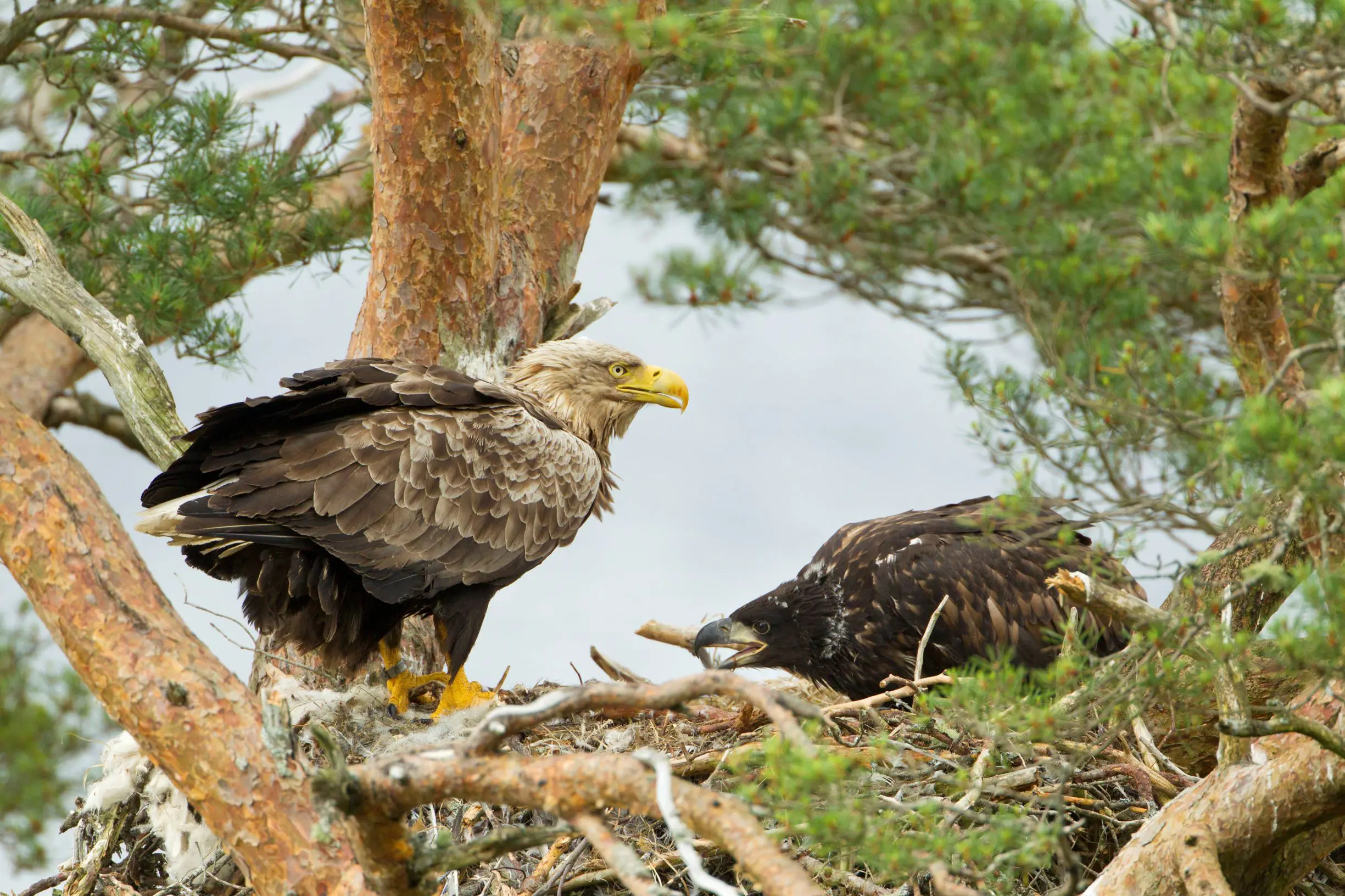
    Sea eagle in next in tree

    Mark Hamblin/2020VISION

    Managing our woodlands for sea eagles

    Give them space. We restrict forestry operations within a 250-metre radius of a sea eagle nest and limit operations around a 500-metre radius during their nesting season. This is when the birds are particularly sensitive to disturbances. We therefore carry out forest management activities near nests during the September to January period.  

    We also encourage people to give these birds of prey space when they are visiting our forests for leisure. 

    Nest Management

    We want to take a proactive approach to nest management which can help dictate where the birds will nest, and limit the restricted areas to quieter parts of the forest. We can do this by creating alternative nests for the birds in areas we want them to be, or plant/keep ‘retention’ stands which are ideal for nests in areas we are felling or thinning.   

    In some places in Scotland, farmers believe that  white-tailed eagles have a negative impact on the viability of their sheep flocks.  To discourage the birds from nesting near fields full of sheep, FLS has been felling trees near such places and providing nesting platforms or suitable nesting sites elsewhere.   

    Roost Management

    The birds are protected from repeated harassment, which means it is illegal to disturb a nest or roost. We work with the White-tailed Eagle Project Team to monitor the roosts built on FLS land.  Sea eagles will sometimes turn established or abandoned roosts into nests during mating season.  

    Lightly thinning around these roosts can help encourage them into becoming nests by making the trees more wind resistant, so understanding where the roosts are is an important part of implementing these strategies.  

    Diversionary Feeding

    FLS also works with partners to test if the provision of ‘food dumps’ during the breeding season will prevent the eagles from foraging on agricultural ground.  Food dumps are sites that are easily accessed by the eagles and where deer offal or ‘road kill’ is regularly placed for them.   

    We are also supporting the National Stakeholder Group's satellite-tagging project, and are trying out different management techniques such as the diversionary feeding and nest-site manipulation in hopes of keeping the birds away from livestock.  

    This new relationship between forest operations and sea eagles is ongoing. It will take time to figure out how we can learn to operate in a way that works with this growing population.

    Latest from FLS

    1. 12 Jan 2026

      Lesley's article

    2. 03 Oct 2025

      Scotland's Climate Week 2025: Working together in the Angus Glens

    3. 29 Sep 2025

      Scotland's Climate Week 2025: Working with partners to support beaver populations

    4. 19 Sep 2025

      Martens on the Move at Kirroughtree

    5. 20 Aug 2025

      Protecting endangered apple trees through teamwork

    Share this article

    • Share on Facebook
    • Share on X
    • Share on LinkedIn

    Feedback

    There is a problem

    Feedback

    Thank you for your feedback

    User feedback form


    Your feedback helps us to improve this website. Do not give any personal information because we cannot reply to you directly.


    Your feedback helps us improve this website. Do not provide any personal information here. If you need to get in touch with a query, please contact us.


    Your feedback helps us improve this website. Do not provide any personal information here. If you need to get in touch with a query, please contact us.

    Forestry and Land Scotland Logo

    Follow us on

    • Forestry and Land Scotland on Facebook
    • Forestry and Land Scotland on Twitter
    • Forestry and Land Scotland on Instagram
    • Forestry and Land Scotland on LinkedIn

    Utilities

    1. Accessibility
    2. Cookies
    3. Privacy Notice
    4. Terms and Conditions
    5. Freedom of Information
    6. Modern Slavery Statement

    Quick links

    1. Media Centre
    Forest Stewardship Council, the mark of responsible forestry Programme for the Endorsement of Forest Certification, PEFC
    © Crown Copyright
    Forests and land that Scotland can be proud of Link to gov.scot gov.scot