Forestry and Land Scotland Logo
  1. Visit
      1. Find a forest
      2. Explore forest parks
    1. Accessible forests
    2. Stay the night
      1. Waymarked trails
      2. Cycling
      3. Mountain biking
      4. Photography
      5. Orienteering
      6. Camping
      7. Treetop adventure
      8. Water sports
      9. Horse riding
      1. Things to see
      2. Trees
      3. Wildlife
      4. Heritage
      5. Things to see in Winter
    3. Plan a visit with a group
    4. Visiting safely
    5. Parking
    Forest map

    Search for a forest by map

    Forests & trails information and closures

    An overview of all closures and high risk warnings on trails.

    Stay the night

    Park overnight in selected forest car parks as part of our motorhome scheme.

  2. About us
      1. Who we are
      2. Our mission and vision
      3. Leadership team
      4. Our values
      1. Careers
      2. Current Vacancies
      3. What we offer
      4. Candidate information
      5. A day in the life
      6. Apprenticeships
    1. Key documents
    2. Our impact
    3. Our approach to Gaelic
    Current Vacancies

    Some text

  3. What we do
      1. Taking Climate Action
      2. The climate emergency
      3. Forest resilience
      4. Peatland restoration
      5. Carbon offsetting
      6. Biodiversity
      7. Renewable energy
      1. Managing the land
      2. Planning our land management
      3. Our sustainable forestry
      4. Our tree nursery
      1. Conservation
      2. Habitat conservation
      3. Wildlife conservation
      4. Historic environment conservation
    1. Supporting outdoor exploration
    2. Working with communities
    3. Our projects
  4. Living and Working
      1. For businesses
      2. Timber sales
      3. Procurements and tenders
      4. Business opportunities
      5. Farming opportunities
      6. Venison sales
      7. Firewood sales
      1. For communities
      2. Transfer land and buildings to your community
      3. Land management plan consultations
      1. Permissions and Permits
      1. Learning and Education
      2. Outdoor learning
      3. Activity sheets
    1. Buy Land or Buildings
    Land management plan consultations

    Text here

    Current job opportunities

    Text here

  5. Get involved
    1. Have your say on consultations
    2. Hold an event
    3. Apply for a community asset transfer (CAT)
    4. Arrange a visit
    5. Work with us
  6. News
  7. Contact
Suggested links
    1. Home
    2. News
    17 November 2020 3 minutes

    Inside the Complex World of Lichen

    Lichen is a hidden gem in our woodlands, often overlooked and underappreciated. 

    Scotland is home to over 1,500 different species of lichen, which makes up around 87% of all lichen found in Britain. Lichens tend to thrive in our relatively clean air, cool summers, mild winters, and our higher levels of rainfall which occur throughout the year. This is especially true of western Scotland, which is home to a large number of rare species and other lichens that live in Scotland’s Rainforest, part of the globally rare temperate rainforest. 

    These hearty organisms may look simple, yet they are more complex than we often realise. Lichen occurs when two or more organisms come together, creating a symbiotic relationship. A symbiotic relationship is when these organisms are so intertwined they often evolve together, like flowers and bees. 

    In the lichen’s case, we have a connection between fungi and alga/blue-green alga. The fungus is the ‘body’ of the lichen, which protects the alga within it, with its intertwined sting-like fungal cells. The alga/blue-green alga provide food as sugars to the fungus through photosynthesis.   

    With lichen, the importance of the relationship differs depending on whether you are the fungi or the algae. Though both organisms benefit from the relationship, the algae can survive on their own, while the fungi need the algae to survive.  

    Lichens are rootless, and instead, take in water directly from the atmosphere, this makes them robust organisms that can grow in harsher environments than most, such as deserts, mountaintops, and frozen landscapes like tundra. In dry conditions they shut down their systems and dry to a crisp. Most lichens look fairly drab when they dry up, but brighten with a whole range of intense colours when wet. 

    Because lichens take in water directly from the atmosphere they can be very sensitive to pollutants, causing them to be more susceptible to changes in our rainwater. 

    We have seen many species of lichen in decline, some becoming locally extinct because of human-related toxins such as sulphur dioxide, ammonia from animal farming, atmospheric nitrogen oxides from exhaust fumes, and other pollutants like ozone.

    However, this sensitivity to change makes lichens useful ‘indicator species’. An indicator species is one that is environmentally sensitive and can therefore help scientists predict changes in like air quality.

    When it comes to air, lichens are used because their level of sensitivity can vary such that we can tell how polluted an area is by the type of lichen growing in it. In areas with lots of agriculture and vehicle traffic, you will see ‘crusty’ lichen. In areas with little air pollution, you’ll find more nitrogen-sensitive or ‘bushy’ and ‘leafy’ lichens that can only survive on clean air. 

    Lichen identification can be a fun activity to do year-round, and Scotland is a perfect place to learn more about these delicate organisms that add personality and colour to our woodlands. Though you should be able to find lichen rather easily, we recommend these locations to go spotting for this underrated organism.
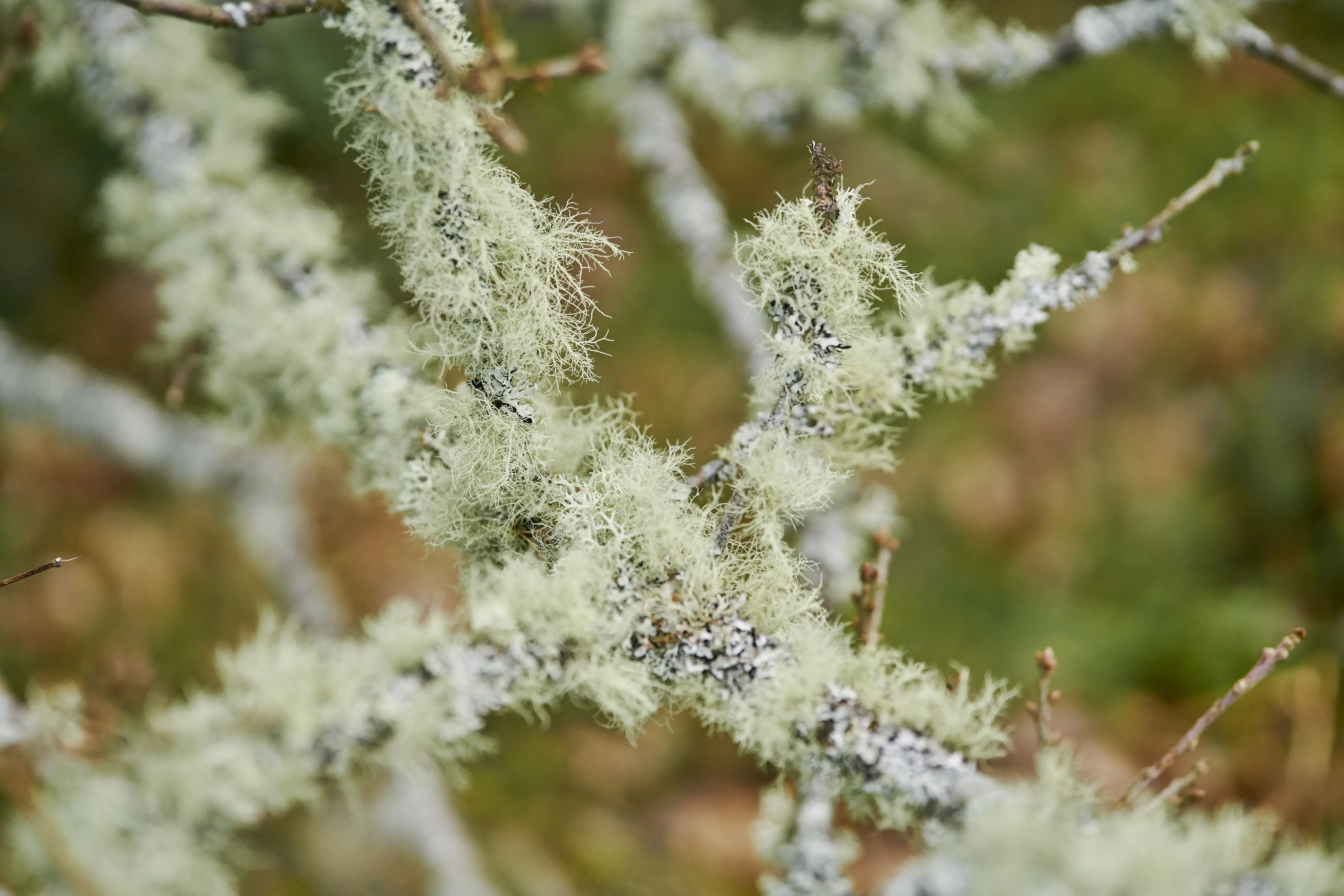
    Old mans beard lichen on tree branchesUsnea or old man's beard lichen. 

    Our favourite lichen forests:

    • Barnluasgan - near Tayvallich
    • Sunart Oakwoods - west of Strontian
    • Glen Nant - near Taynuilt 

    Latest from FLS

    1. 12 Jan 2026

      Lesley's article

    2. 03 Oct 2025

      Scotland's Climate Week 2025: Working together in the Angus Glens

    3. 29 Sep 2025

      Scotland's Climate Week 2025: Working with partners to support beaver populations

    4. 19 Sep 2025

      Martens on the Move at Kirroughtree

    5. 20 Aug 2025

      Protecting endangered apple trees through teamwork

    Share this article

    • Share on Facebook
    • Share on X
    • Share on LinkedIn

    Feedback

    There is a problem

    Feedback

    Thank you for your feedback

    User feedback form


    Your feedback helps us to improve this website. Do not give any personal information because we cannot reply to you directly.


    Your feedback helps us improve this website. Do not provide any personal information here. If you need to get in touch with a query, please contact us.


    Your feedback helps us improve this website. Do not provide any personal information here. If you need to get in touch with a query, please contact us.

    Forestry and Land Scotland Logo

    Follow us on

    • Forestry and Land Scotland on Facebook
    • Forestry and Land Scotland on Twitter
    • Forestry and Land Scotland on Instagram
    • Forestry and Land Scotland on LinkedIn

    Utilities

    1. Accessibility
    2. Cookies
    3. Privacy Notice
    4. Terms and Conditions
    5. Freedom of Information
    6. Modern Slavery Statement

    Quick links

    1. Media Centre
    Forest Stewardship Council, the mark of responsible forestry Programme for the Endorsement of Forest Certification, PEFC
    © Crown Copyright
    Forests and land that Scotland can be proud of Link to gov.scot gov.scot