Forestry and Land Scotland Logo
  1. Visit
      1. Find a forest
      2. Explore forest parks
    1. Accessible forests
    2. Stay the night
      1. Waymarked trails
      2. Cycling
      3. Mountain biking
      4. Photography
      5. Orienteering
      6. Camping
      7. Treetop adventure
      8. Water sports
      9. Horse riding
      1. Things to see
      2. Trees
      3. Wildlife
      4. Heritage
      5. Things to see in Winter
    3. Plan a visit with a group
    4. Visiting safely
    5. Parking
    Forest map

    Search for a forest by map

    Forests & trails information and closures

    An overview of all closures and high risk warnings on trails.

    Stay the night

    Park overnight in selected forest car parks as part of our motorhome scheme.

  2. About us
      1. Who we are
      2. Our mission and vision
      3. Leadership team
      4. Our values
      1. Careers
      2. Current Vacancies
      3. What we offer
      4. Candidate information
      5. A day in the life
      6. Apprenticeships
    1. Key documents
    2. Our impact
    3. Our approach to Gaelic
    Current Vacancies

    Some text

  3. What we do
      1. Taking Climate Action
      2. The climate emergency
      3. Forest resilience
      4. Peatland restoration
      5. Carbon offsetting
      6. Biodiversity
      7. Renewable energy
      1. Managing the land
      2. Planning our land management
      3. Our sustainable forestry
      4. Our tree nursery
      1. Conservation
      2. Habitat conservation
      3. Wildlife conservation
      4. Historic environment conservation
    1. Supporting outdoor exploration
    2. Working with communities
    3. Our projects
  4. Living and Working
      1. For businesses
      2. Timber sales
      3. Procurements and tenders
      4. Business opportunities
      5. Farming opportunities
      6. Venison sales
      7. Firewood sales
      1. For communities
      2. Transfer land and buildings to your community
      3. Land management plan consultations
      1. Permissions and Permits
      1. Learning and Education
      2. Outdoor learning
      3. Activity sheets
    1. Buy Land or Buildings
    Land management plan consultations

    Text here

    Current job opportunities

    Text here

  5. Get involved
    1. Have your say on consultations
    2. Hold an event
    3. Apply for a community asset transfer (CAT)
    4. Arrange a visit
    5. Work with us
  6. News
  7. Contact
Suggested links
    1. Home
    2. News
    21 December 2023 4 minutes

    Dig deeper: the Bare Bones of Bargrennan Cairns

    To celebrate our archaeological learning resource The Bare Bones being nominated in the Current Archaeology Awards 2024 ‘Research Project of the Year’ category, we thought that we would shine a light on another intriguing type of Neolithic chambered cairn – the Bargrennan cairn.

    Several of these cairns can be found on Scotland’s national forests and land, including the White Cairn in Galloway and the Bencallen Cairn in South Ayrshire.
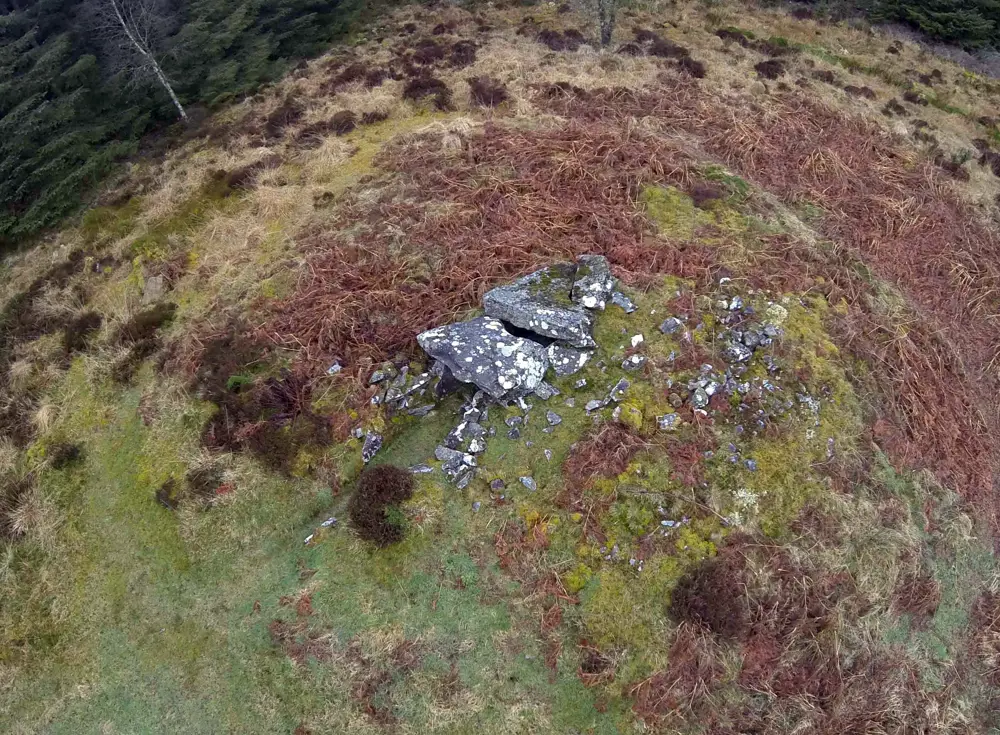
    1 Bargrennan Cairn copyright AOC Archaeology

    The White Cairn of Bargrennan measures around 14 m in diameter and still stands about 1.4m in height. It’s passage and chamber are clearly visible.

    The White Cairn of Bargrennan in Galloway was excavated by Professors Piggott and Powell in 1949. It’s the first site where the distinct ‘Bargrennan’ class of chambered cairn was recognised, and one of only a dozen of these cairns of this type to have survived. They are mostly found in Galloway.

    A typical Bargrennan cairn is circular on plan and contains at least one simple passage and chamber. They have similarities to the Clyde cairns and court tombs of the North Channel, with their rectangular chambers, but are covered by circular cairns rather than trapezoidal ones, and lack the famous curving façade. However, they may not be contemporary traditions; while the chambered cairns of the north Channel are early Neolithic in date, the Bargrennan cairns may be late Neolithic in date. They are also usually found in isolated upland basins, while Clyde cairns and court tombs are usually located in the lower lying coastal zone, often with views of the sea.
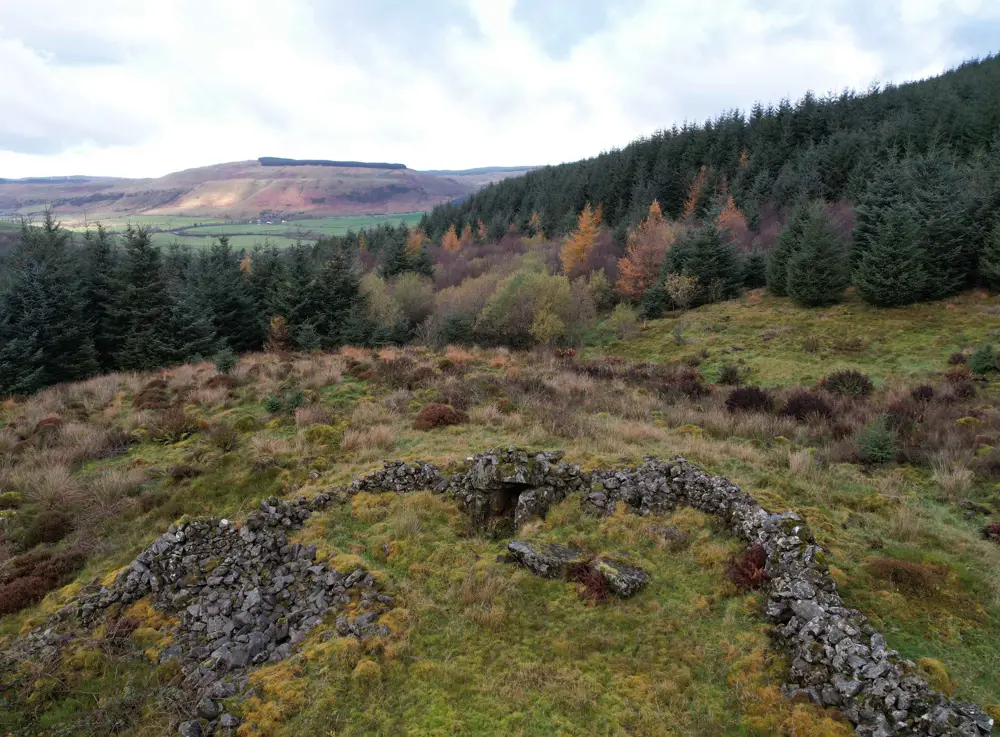
    2 Bencallen Cairn copyright Matt Ritchie

    The Bencallen Cairn has been extensively robbed to build a later sheepfold. It may have measured around 16 m in diameter. Its passage is choked with rubble and the rear of its chamber has been destroyed.

    The White Cairn has a passage that gradually widens from the threshold towards the back of the chamber. However, only two massive lintel stones remain in place today. The Bencallen Cairn is located further to the north, in South Ayrshire. It has been badly damaged, with much of its stone cairn removed to build a later sheepfold. It has fine views towards the Stinchar Valley.

    The White Cairn and the Bencallen Cairn both help to demonstrate the conservation narrative at the heart of The Bare Bones. The passage and chamber of the White Cairn have been cleared, and the cairn is accessible and presented to the public. The Bencallen Cairn has been largely robbed away to build a more recent sheepfold. Only part of its chamber remains visible, and the outline of its circular covering cairn is only visible from the air.

    Exploring the conservation narrative of these monuments can help us better understand and appreciate these silent stones from a time long since passed.

    In recent years, new methods of digital documentation have added powerful tools to the archaeological arsenal. In the case of chambered cairns, photogrammetry and 3D laser-scanning technologies represent detailed methods of objective recording which can be used to better appreciate the scale and form of these monuments. These new techniques provided a rich seam of illustrations for The Bare Bones, complementing drone photography, archaeological measured drawings, and a host of new imaginative visualisations. There have never before been so many ways to present the past in such vivid detail.
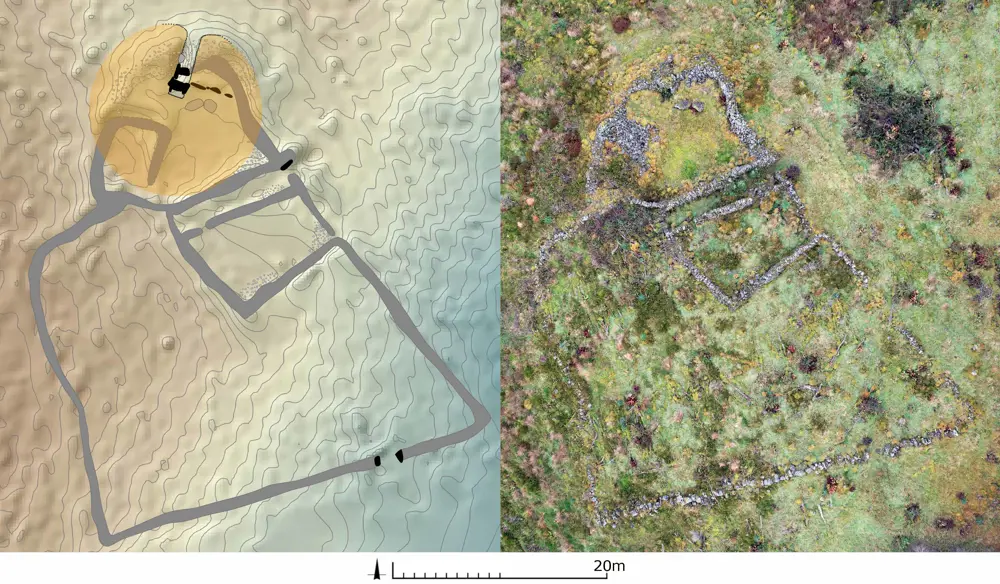
    3 Bencallen Cairn PLAN and AP copyright AOC Archaeology and Matt Ritchie

    This topographic plan and vertical aerial photograph of the Bencallen Cairn and later sheepfold has been annotated in orange to show the approximate extent of the round cairn, and its narrow passage widening into the chamber. Two possible lintel slabs or orthostats can be seen lying just to the SE.
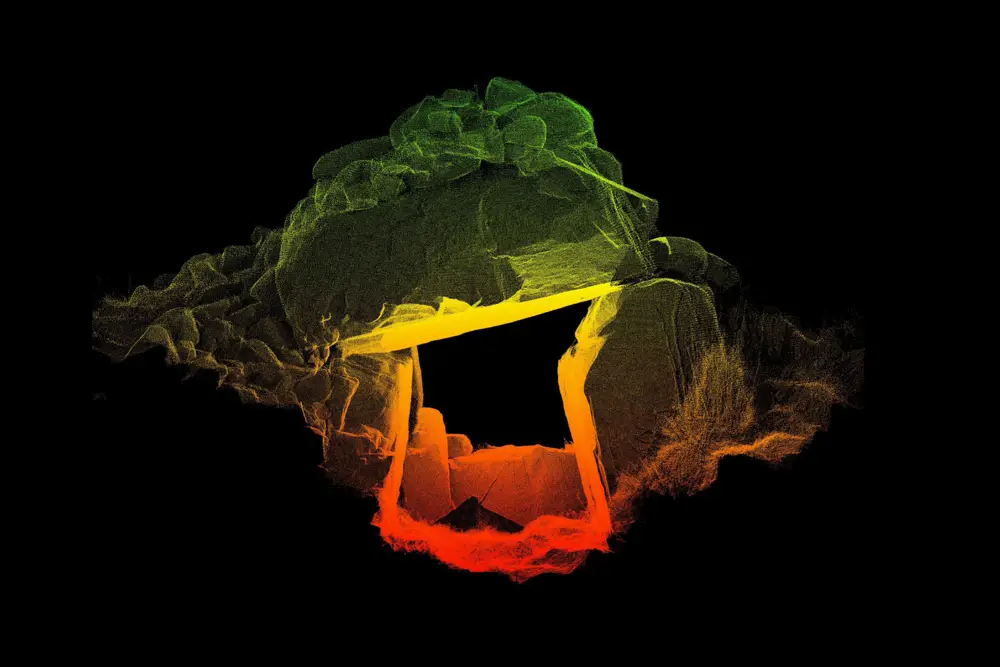
    4 Bencallen Cairn POINTCLOUD copyright AOC Archaeology

    This view of the point cloud resulting from an archaeological laser scan survey of the Bencallen cairn in 2015 looks under the massive lintel stone into the rear of the chamber; you can see the low sill stone that separates the chamber from the passage.

    The Bargrennan cairns, with their round covering cairns, rectangular chambers, simple passages and, in some examples, their multiple radial chambers, display striking architectural similarities with similar round cairns on Arran, the Isle of Man and in North Wales: another regional tradition, this time shared by Neolithic and Early Bronze Age communities across the Irish Sea.

    You can vote for this year’s Current Archaeology research project below:

    Current Archaeology Awards


    Latest from FLS

    1. 12 Jan 2026

      Lesley's article

    2. 03 Oct 2025

      Scotland's Climate Week 2025: Working together in the Angus Glens

    3. 29 Sep 2025

      Scotland's Climate Week 2025: Working with partners to support beaver populations

    4. 19 Sep 2025

      Martens on the Move at Kirroughtree

    5. 20 Aug 2025

      Protecting endangered apple trees through teamwork

    Share this article

    • Share on Facebook
    • Share on X
    • Share on LinkedIn

    Feedback

    There is a problem

    Feedback

    Thank you for your feedback

    User feedback form


    Your feedback helps us to improve this website. Do not give any personal information because we cannot reply to you directly.


    Your feedback helps us improve this website. Do not provide any personal information here. If you need to get in touch with a query, please contact us.


    Your feedback helps us improve this website. Do not provide any personal information here. If you need to get in touch with a query, please contact us.

    Forestry and Land Scotland Logo

    Follow us on

    • Forestry and Land Scotland on Facebook
    • Forestry and Land Scotland on Twitter
    • Forestry and Land Scotland on Instagram
    • Forestry and Land Scotland on LinkedIn

    Utilities

    1. Accessibility
    2. Cookies
    3. Privacy Notice
    4. Terms and Conditions
    5. Freedom of Information
    6. Modern Slavery Statement

    Quick links

    1. Media Centre
    Forest Stewardship Council, the mark of responsible forestry Programme for the Endorsement of Forest Certification, PEFC
    © Crown Copyright
    Forests and land that Scotland can be proud of Link to gov.scot gov.scot