Forestry and Land Scotland Logo
  1. Visit
      1. Find a forest
      2. Explore forest parks
    1. Accessible forests
    2. Stay the night
      1. Waymarked trails
      2. Cycling
      3. Mountain biking
      4. Photography
      5. Orienteering
      6. Camping
      7. Treetop adventure
      8. Water sports
      9. Horse riding
      1. Things to see
      2. Trees
      3. Wildlife
      4. Heritage
      5. Things to see in Winter
    3. Plan a visit with a group
    4. Visiting safely
    5. Parking
    Forest map

    Search for a forest by map

    Forests & trails information and closures

    An overview of all closures and high risk warnings on trails.

    Stay the night

    Park overnight in selected forest car parks as part of our motorhome scheme.

  2. About us
      1. Who we are
      2. Our mission and vision
      3. Leadership team
      4. Our values
      1. Careers
      2. Current Vacancies
      3. What we offer
      4. Candidate information
      5. A day in the life
      6. Apprenticeships
    1. Key documents
    2. Our impact
    3. Our approach to Gaelic
    Current Vacancies

    Some text

  3. What we do
      1. Taking Climate Action
      2. The climate emergency
      3. Forest resilience
      4. Peatland restoration
      5. Carbon offsetting
      6. Biodiversity
      7. Renewable energy
      1. Managing the land
      2. Planning our land management
      3. Our sustainable forestry
      4. Our tree nursery
      1. Conservation
      2. Habitat conservation
      3. Wildlife conservation
      4. Historic environment conservation
    1. Supporting outdoor exploration
    2. Working with communities
    3. Our projects
  4. Living and Working
      1. For businesses
      2. Timber sales
      3. Procurements and tenders
      4. Business opportunities
      5. Farming opportunities
      6. Venison sales
      7. Firewood sales
      1. For communities
      2. Transfer land and buildings to your community
      3. Land management plan consultations
      1. Permissions and Permits
      1. Learning and Education
      2. Outdoor learning
      3. Activity sheets
    1. Buy Land or Buildings
    Land management plan consultations

    Text here

    Current job opportunities

    Text here

  5. Get involved
    1. Have your say on consultations
    2. Hold an event
    3. Apply for a community asset transfer (CAT)
    4. Arrange a visit
    5. Work with us
  6. News
  7. Contact
Suggested links
    1. Home
    2. News
    29 January 2024 3 minutes

    Dig deeper: revealing the ruins of Brunell Township

    The low stone walls and earthen banks of a post-medieval township were recently discovered in Glen Brittle Forest on the Isle of Skye during an environmental check ahead of harvesting.

    Likely dating from the 17th and 18th centuries, the township comprises a range of houses, byres, barns and corn-drying kilns. The buildings were located within a mature conifer plantation of predominantly Sitka spruce that was planted in 1977, with many sites partially masked by windblown trees.
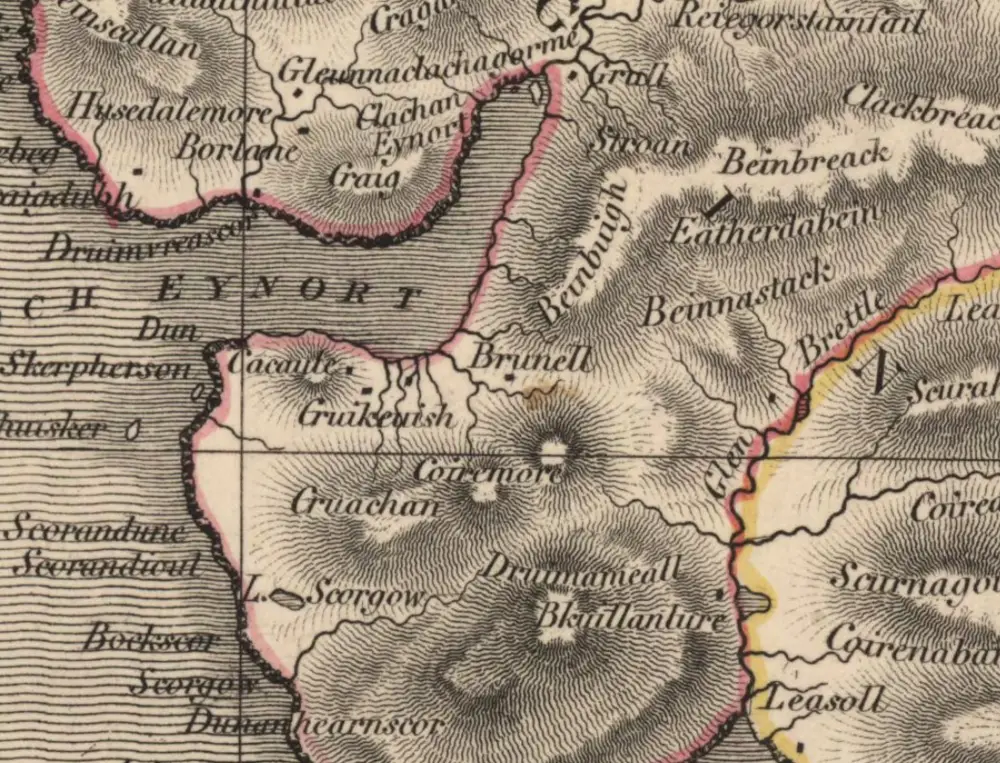
    An old ordinance survey of the area

    We recently commissioned a detailed survey by AOC Archaeology. Before their fieldwork, the archaeologists first looked at the historic records. They discovered that the township is referred to as Brunell on an early 19th century map (pictured above), surveyed by John Thomson in 1832. Then they consulted the Old and New Statistical Accounts for the Parish of Bracadale on Skye. There was no specific information about the township itself, but there were general descriptions of life in the parish:

    “the parish produces black cattle, sheep and horses. Black cattle is the main staple... from the returns of which the people pay their rents and supply themselves with necessities. There are small quantities of sheep on each farm, but there is no farm laid out entirely to sheep pasture” (Bracadale, County of Inverness, OSA, Vol. 22, 1792).


    Almost 50 years later, the minister reported that “at the time of the last [Old] Statistical Account, the population was 2250 souls. By the last census it was 1769, and since that period there has been a farther decrease. This decrease is solely to be ascribed to the system of farming which has for some time been adopted: throwing a number of farms into one large tack for sheep-grazing, and dispossessing and setting adrift the small tenants” (Bracadale, County of Inverness, NSA, Vol. 14, 1840). This was the fate that lay in store for the inhabitants of Brunell. The township was deserted by the time of the first Ordnance Survey, who depict only two unroofed buildings and a field on their map from 1881.
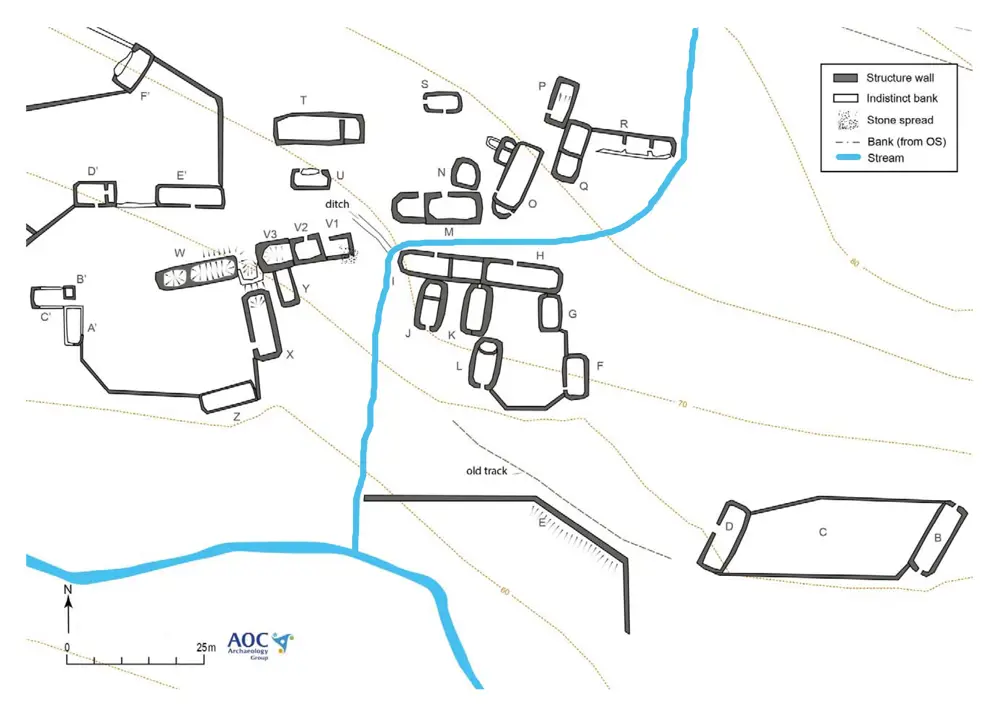
    a map of the buildings on site

    Twenty-eight buildings were recorded by the archaeological survey, clustered together with fields and stock enclosures to form a small clachan (or township), set on terraces on the N side of the Allt Dabhoch burn.
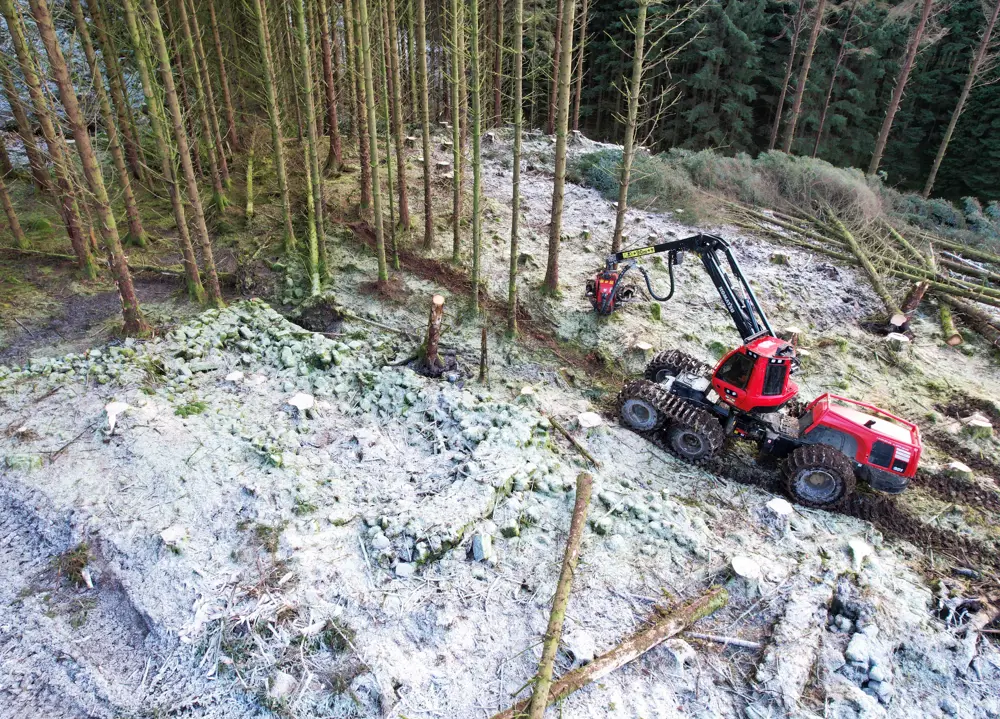
    A red harvesting machine removing trees with snow around it

    The archaeological survey was then used to inform the careful planning and delivery of a clear fell operation by Highland Timber Harvesting on behalf of Tilhill. The individual buildings were first marked out on the ground. The machine operators then used their skill and experience to carefully plan the harvesting operation, using short tracks to work their way around the township and felling trees into open space, away from the buildings to avoid causing any damage.
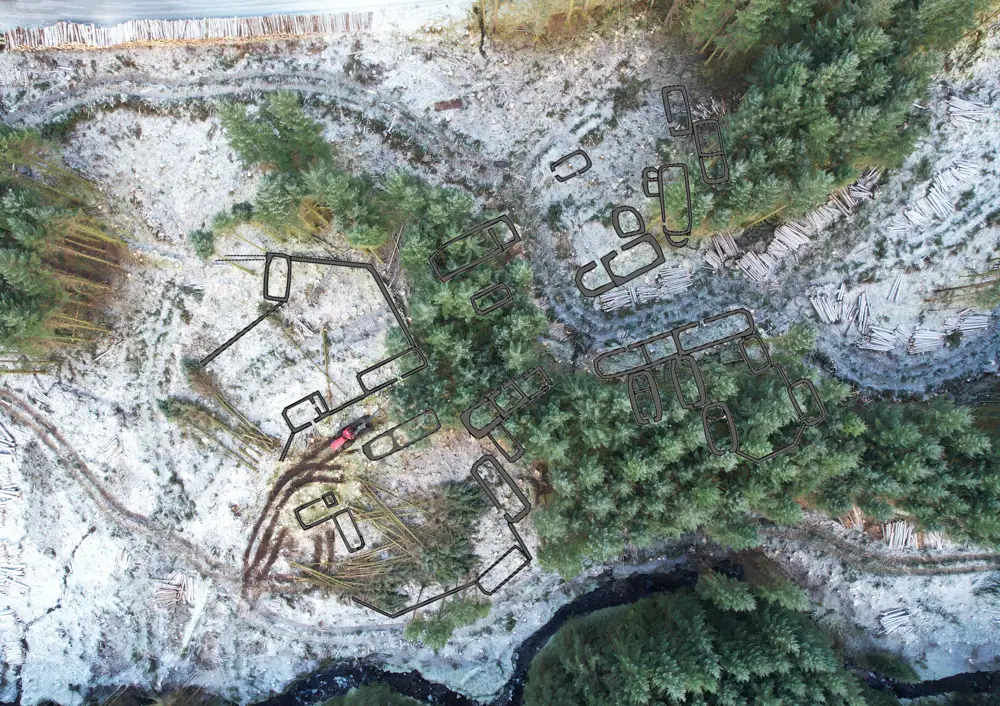
    Ariel view of the building in the felling site

    This vertical aerial view of the harvesting operation in and around the township has been annotated to show the location of the buildings. Some of the buildings are now readily visible in cleared areas, while some remain under trees. You can see how the harvester is operating between the buildings, using short tracks planned to best navigate around the township. The harvester positions itself to reach over the buildings to carefully fell trees away from their walls into open space, ready for processing into logs to be neatly stacked ready for removal by the forwarder. The forwarder is using the same tracks to bring the logs to the roadside, ready for loading onto timber lorries.

    Latest from FLS

    1. 12 Jan 2026

      Lesley's article

    2. 03 Oct 2025

      Scotland's Climate Week 2025: Working together in the Angus Glens

    3. 29 Sep 2025

      Scotland's Climate Week 2025: Working with partners to support beaver populations

    4. 19 Sep 2025

      Martens on the Move at Kirroughtree

    5. 20 Aug 2025

      Protecting endangered apple trees through teamwork

    Share this article

    • Share on Facebook
    • Share on X
    • Share on LinkedIn

    Feedback

    There is a problem

    Feedback

    Thank you for your feedback

    User feedback form


    Your feedback helps us to improve this website. Do not give any personal information because we cannot reply to you directly.


    Your feedback helps us improve this website. Do not provide any personal information here. If you need to get in touch with a query, please contact us.


    Your feedback helps us improve this website. Do not provide any personal information here. If you need to get in touch with a query, please contact us.

    Forestry and Land Scotland Logo

    Follow us on

    • Forestry and Land Scotland on Facebook
    • Forestry and Land Scotland on Twitter
    • Forestry and Land Scotland on Instagram
    • Forestry and Land Scotland on LinkedIn

    Utilities

    1. Accessibility
    2. Cookies
    3. Privacy Notice
    4. Terms and Conditions
    5. Freedom of Information
    6. Modern Slavery Statement

    Quick links

    1. Media Centre
    Forest Stewardship Council, the mark of responsible forestry Programme for the Endorsement of Forest Certification, PEFC
    © Crown Copyright
    Forests and land that Scotland can be proud of Link to gov.scot gov.scot