Forestry and Land Scotland Logo
  1. Visit
      1. Find a forest
      2. Explore forest parks
    1. Accessible forests
    2. Stay the night
      1. Waymarked trails
      2. Cycling
      3. Mountain biking
      4. Photography
      5. Orienteering
      6. Camping
      7. Treetop adventure
      8. Water sports
      9. Horse riding
      1. Things to see
      2. Trees
      3. Wildlife
      4. Heritage
      5. Things to see in Winter
    3. Plan a visit with a group
    4. Visiting safely
    5. Parking
    Forest map

    Search for a forest by map

    Forests & trails information and closures

    An overview of all closures and high risk warnings on trails.

    Stay the night

    Park overnight in selected forest car parks as part of our motorhome scheme.

  2. About us
      1. Who we are
      2. Our mission and vision
      3. Leadership team
      4. Our values
      1. Careers
      2. Current Vacancies
      3. What we offer
      4. Candidate information
      5. A day in the life
      6. Apprenticeships
    1. Key documents
    2. Our impact
    3. Our approach to Gaelic
    Current Vacancies

    Some text

  3. What we do
      1. Taking Climate Action
      2. The climate emergency
      3. Forest resilience
      4. Peatland restoration
      5. Carbon offsetting
      6. Biodiversity
      7. Renewable energy
      1. Managing the land
      2. Planning our land management
      3. Our sustainable forestry
      4. Our tree nursery
      1. Conservation
      2. Habitat conservation
      3. Wildlife conservation
      4. Historic environment conservation
    1. Supporting outdoor exploration
    2. Working with communities
    3. Our projects
  4. Living and Working
      1. For businesses
      2. Timber sales
      3. Procurements and tenders
      4. Business opportunities
      5. Farming opportunities
      6. Venison sales
      7. Firewood sales
      1. For communities
      2. Transfer land and buildings to your community
      3. Land management plan consultations
      1. Permissions and Permits
      1. Learning and Education
      2. Outdoor learning
      3. Activity sheets
    1. Buy Land or Buildings
    Land management plan consultations

    Text here

    Current job opportunities

    Text here

  5. Get involved
    1. Have your say on consultations
    2. Hold an event
    3. Apply for a community asset transfer (CAT)
    4. Arrange a visit
    5. Work with us
  6. News
  7. Contact
Suggested links
    1. Home
    2. News
    09 May 2019 4 minutes

    Lek It Be: Black Grouse mating season
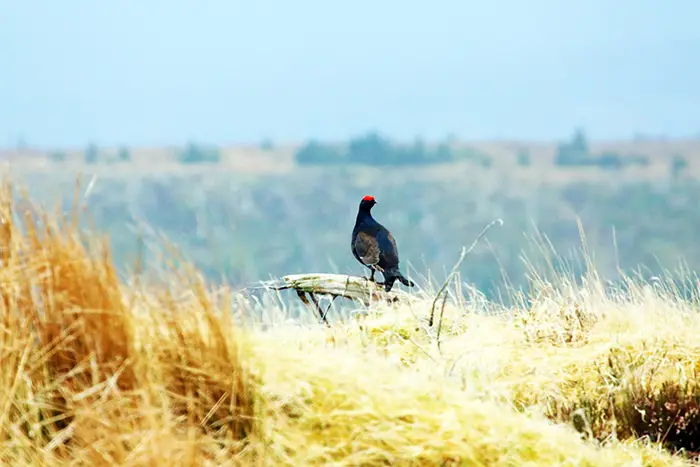
    Black game bird with red beak perched on dead tree branch in field of tussocky yellow grass

    The photo above, taken last week by one of our rangers in the North Highlands, shows a black grouse, with its unmistakable postbox-red crest and blue-black feathers. The ‘lekking’ season is when black grouse breed, and a few of our destinations have been affected, with roadworks in Galloway Forest Park delayed in order to give the grouse population room to manoeuvre. “Not wanting to get in the way of love, we have decided to keep the forest drive closed for a few weeks,” reports ranger Lucy Hadley, who is on the lookout for these rarely-spotted birds in her district.

    Sadly, the black grouse population is the fastest-declining in the UK. As an endangered species, we want to do everything we can to support the native breeding population. The larger cousin of the black grouse, the capercaillie, is near-extinct in Scotland, and we don’t want to see that happening to the black grouse.

    To throw some more light on the mating habits, characteristics and best places to spot black grouse, we spoke to Environment Forester and bird expert Gareth Ventress. Read what he has to say below, and find out all about the mysterious and dramatic lekking display.

    The ‘Lek’ - a battle for supremacy

    Black grouse can be seen throughout the year but are at their most flamboyant and noticeable during the lek, when males visit a spot as a group, to display, in the hope of mating. The lek generally begins to heat up in early April, raising to its peak around early to mid-May when the females, known as Greyhens, decide to grace the lek with their presence to select their mate.

    - Gareth Ventress
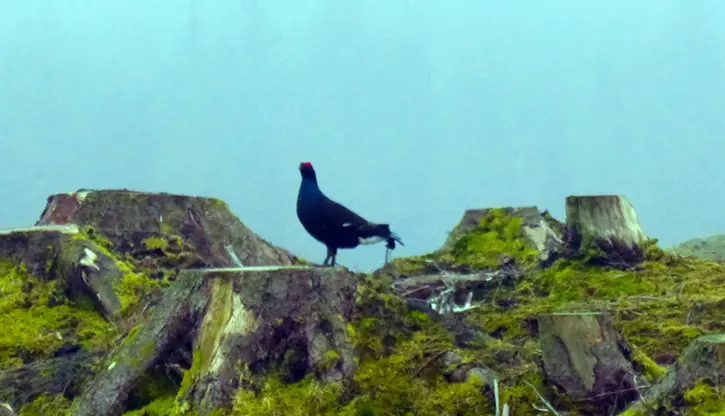
    Black game bird perched on stump of felled tree amongst many other tree stumps

    A black cock surveys the landscape in search of a partner or a rival. Photo: G Ventress

    During the lek the male black grouse, known as black cock, display their vitality by displaying against each other. They show of their tail fans, and go through a fairly ritualised series of dance moves whilst issuing a beautiful soft bubbling call, punctuated by a harsh ‘kweek’ sound, often emitted during a wing-fluttering jump.

    This dance off often turns violent, with cock birds pecking and kicking at each other as the lek reaches its peak. Some of the birds begin to look a little bedraggled, with feathers missing from around their head and necks and ragged wattles above their eyes. It’s all worthwhile for the fittest cocks though, because by asserting their dominance, multiple females may decide to mate with them, and they can assure their genes are passed onto the next generation. As for the losers, there is always next spring. Perhaps next time the clocks go forward they will be the fittest cock on the block!

    Where to see black grouse

    Black grouse lek throughout Galloway Forest Park, with leks often just a few hundred meters off some forest roads - and occasionally on the road itself.
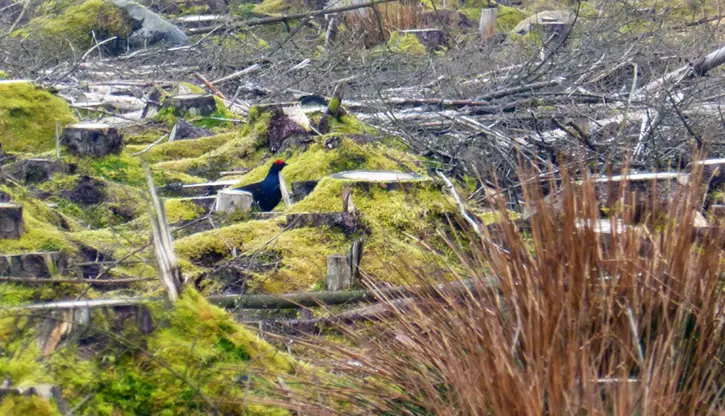
    Black game bird sitting on tree stump amongst a grassy hillside with several other tree stumps

    Rare, but with a distinctive appearance, black grouse are relatively easy to spot.
    Photo: G. Ventress

    Black grouse are known as a woodland edge species, preferring the woodland fringe habitats as the plantation transitions into open moorland. In Galloway we are working to improve this habitat through forest restructuring by creating a more natural woodland fringe of low density broadleaved trees and open space, and restoring important nesting and chick rearing habitats like blanket bogs.

    We also protect the lek sites from disturbance during the most sensitive time of the year through implementing large buffer zones around each lek, where we restrict any operational forestry or civil engineering works to allow the birds to display and mate in peace.


    Latest from FLS

    1. 12 Jan 2026

      Lesley's article

    2. 03 Oct 2025

      Scotland's Climate Week 2025: Working together in the Angus Glens

    3. 29 Sep 2025

      Scotland's Climate Week 2025: Working with partners to support beaver populations

    4. 19 Sep 2025

      Martens on the Move at Kirroughtree

    5. 20 Aug 2025

      Protecting endangered apple trees through teamwork

    Share this article

    • Share on Facebook
    • Share on X
    • Share on LinkedIn

    Feedback

    There is a problem

    Feedback

    Thank you for your feedback

    User feedback form


    Your feedback helps us to improve this website. Do not give any personal information because we cannot reply to you directly.


    Your feedback helps us improve this website. Do not provide any personal information here. If you need to get in touch with a query, please contact us.


    Your feedback helps us improve this website. Do not provide any personal information here. If you need to get in touch with a query, please contact us.

    Forestry and Land Scotland Logo

    Follow us on

    • Forestry and Land Scotland on Facebook
    • Forestry and Land Scotland on Twitter
    • Forestry and Land Scotland on Instagram
    • Forestry and Land Scotland on LinkedIn

    Utilities

    1. Accessibility
    2. Cookies
    3. Privacy Notice
    4. Terms and Conditions
    5. Freedom of Information
    6. Modern Slavery Statement

    Quick links

    1. Media Centre
    Forest Stewardship Council, the mark of responsible forestry Programme for the Endorsement of Forest Certification, PEFC
    © Crown Copyright
    Forests and land that Scotland can be proud of Link to gov.scot gov.scot