Forestry and Land Scotland Logo
  1. Visit
      1. Find a forest
      2. Explore forest parks
    1. Accessible forests
    2. Stay the night
      1. Waymarked trails
      2. Cycling
      3. Mountain biking
      4. Photography
      5. Orienteering
      6. Camping
      7. Treetop adventure
      8. Water sports
      9. Horse riding
      1. Things to see
      2. Trees
      3. Wildlife
      4. Heritage
      5. Things to see in Winter
    3. Plan a visit with a group
    4. Visiting safely
    5. Parking
    Forest map

    Search for a forest by map

    Forests & trails information and closures

    An overview of all closures and high risk warnings on trails.

    Stay the night

    Park overnight in selected forest car parks as part of our motorhome scheme.

  2. About us
      1. Who we are
      2. Our mission and vision
      3. Leadership team
      4. Our values
      1. Careers
      2. Current Vacancies
      3. What we offer
      4. Candidate information
      5. A day in the life
      6. Apprenticeships
    1. Key documents
    2. Our impact
    3. Our approach to Gaelic
    Current Vacancies

    Some text

  3. What we do
      1. Taking Climate Action
      2. The climate emergency
      3. Forest resilience
      4. Peatland restoration
      5. Carbon offsetting
      6. Biodiversity
      7. Renewable energy
      1. Managing the land
      2. Planning our land management
      3. Our sustainable forestry
      4. Our tree nursery
      1. Conservation
      2. Habitat conservation
      3. Wildlife conservation
      4. Historic environment conservation
    1. Supporting outdoor exploration
    2. Working with communities
    3. Our projects
  4. Living and Working
      1. For businesses
      2. Timber sales
      3. Procurements and tenders
      4. Business opportunities
      5. Farming opportunities
      6. Venison sales
      7. Firewood sales
      1. For communities
      2. Transfer land and buildings to your community
      3. Land management plan consultations
      1. Permissions and Permits
      1. Learning and Education
      2. Outdoor learning
      3. Activity sheets
    1. Buy Land or Buildings
    Land management plan consultations

    Text here

    Current job opportunities

    Text here

  5. Get involved
    1. Have your say on consultations
    2. Hold an event
    3. Apply for a community asset transfer (CAT)
    4. Arrange a visit
    5. Work with us
  6. News
  7. Contact
Suggested links
    1. Home
    2. News
    03 November 2020 3 minutes

    Bats at Tentsmuir Forest

    Until recently conifer woodlands were not known to be great places for bats, but Tentsmuir Forest was at the forefront of changing these perceptions.

    In 1985 the first bat boxes were put up by the Fife Bat Group (now known as the Fife and Kinross Bat Group). Colonies of pipistrelle bats quickly moved into these boxes but, more surprisingly, they noticed the arrival of natterer's bats, a bat normally associated with broad-leaved woodlands.
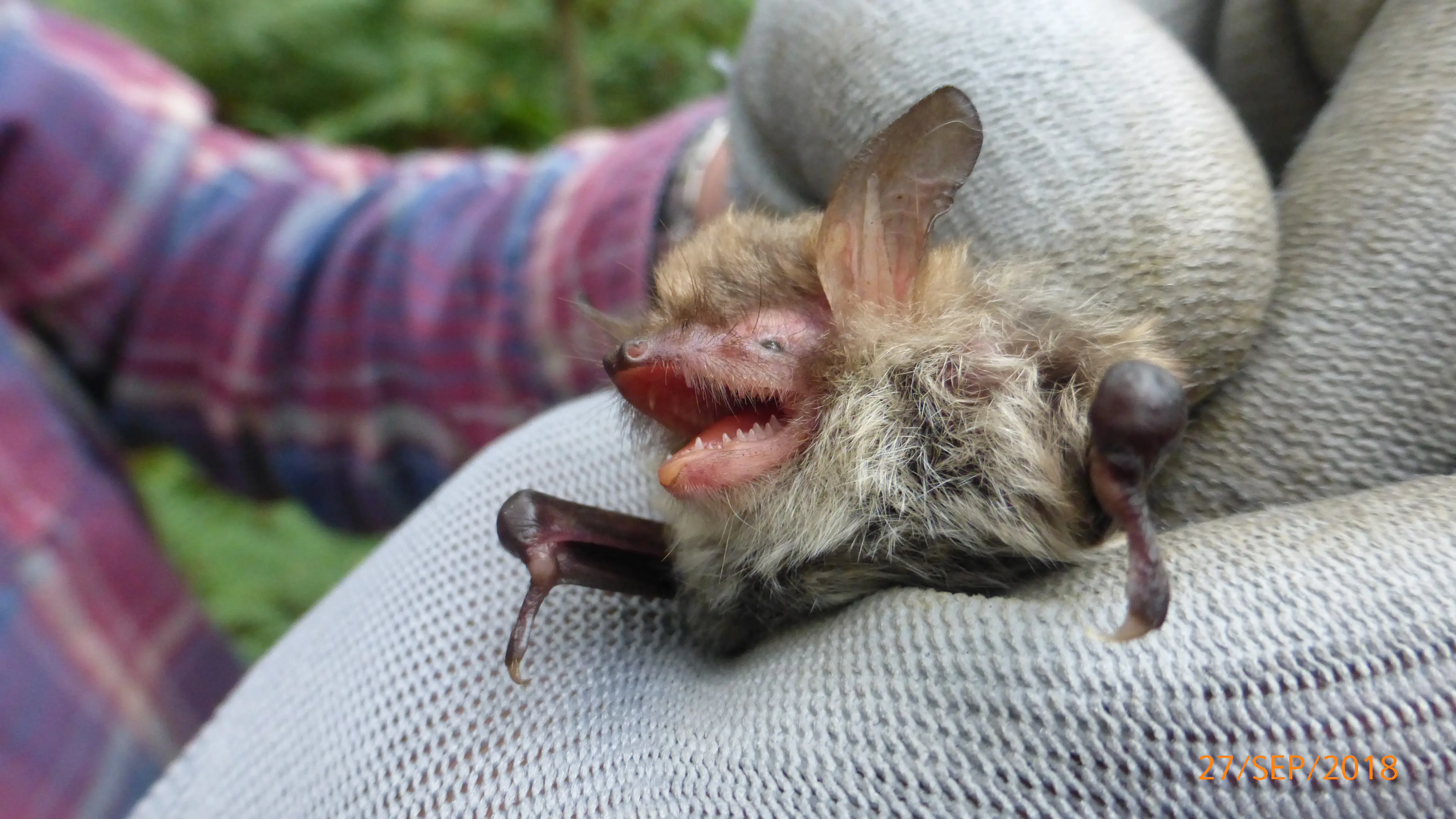
    Female Natterers bat in Kilsture Wood Galloway

    Photo: Natterer's Bat

    The Fife Bat Group continued to monitor the Tentsmuir bat boxes throughout the '80s and '90s. During this time, interest in the natterer's grew and we started to want to know more about these nocturnal creatures.

    We started using bat ringing to study the population and housing dynamics of the bats. But to do this we needed to bring in an expert. Sue Swift, a legend in the bat world and a national treasure in Scottish batting, kindly came and trained members of the bat group on how to safely fit the bats with rings.

    Since then the scheme has never looked back with over 2,000 captured and tagged bats. Remarkably, some of those first natterer’s ringed in 1998 were still alive and raising pups in 2019. The ringing has taught us a great deal about the natterer’s living in Tentsmuir.

    Three key findings:

    • The same bats come back year after year and the population is remarkably stable with high survival rates;
    • Distinct clusters are living in the east and west parts of the forest with very little cross over in ranges;
    • There was much excitement when the first Tentsmuir natterer’s bat appeared in one of the few known hibernations sites 26 km from the forest.

    The next leap in our understanding of how bats use Tentsmuir Forest came in 2003-2004 when Garry Mortimer completed his PhD at the site. With enormous support from what was then known as Forest Enterprise, and particularly local forest ranger John Montgomery, a plan was hatched to capture and radio tag natterer’s bats.

    This was a tough and demanding project that required the scientists to track the bats at night - in their cars. What we discovered from Garry’s work was that bats used a large number of conifer trees to roost in, in addition to the boxes. We observed that bats used the joints of Scots and Corsican pines that have double leaders. These hard to see knot holes became an ideal place for highly mobile maternity colonies, showing us that conifer forests could support natterer's bat roosts even before we started our bat project.

    The project also observed that the bats used a wide range of the forest to forage, including both wetland sites around the forest (the fire ponds and the adjacent Morton Lochs) and amongst the conifers themselves which are abundant with insect life.

    The Fife and Kinross Bat Group are not currently handling and ringing bats due to COVID-19. However, we look forward to catching up with our old friends when this is over, in the full and certain knowledge that some of the bats will be older than the people studying them. 

    Audio credit: Bat Conservation Trust

    Latest from FLS

    1. 12 Jan 2026

      Lesley's article

    2. 03 Oct 2025

      Scotland's Climate Week 2025: Working together in the Angus Glens

    3. 29 Sep 2025

      Scotland's Climate Week 2025: Working with partners to support beaver populations

    4. 19 Sep 2025

      Martens on the Move at Kirroughtree

    5. 20 Aug 2025

      Protecting endangered apple trees through teamwork

    Share this article

    • Share on Facebook
    • Share on X
    • Share on LinkedIn

    Feedback

    There is a problem

    Feedback

    Thank you for your feedback

    User feedback form


    Your feedback helps us to improve this website. Do not give any personal information because we cannot reply to you directly.


    Your feedback helps us improve this website. Do not provide any personal information here. If you need to get in touch with a query, please contact us.


    Your feedback helps us improve this website. Do not provide any personal information here. If you need to get in touch with a query, please contact us.

    Forestry and Land Scotland Logo

    Follow us on

    • Forestry and Land Scotland on Facebook
    • Forestry and Land Scotland on Twitter
    • Forestry and Land Scotland on Instagram
    • Forestry and Land Scotland on LinkedIn

    Utilities

    1. Accessibility
    2. Cookies
    3. Privacy Notice
    4. Terms and Conditions
    5. Freedom of Information
    6. Modern Slavery Statement

    Quick links

    1. Media Centre
    Forest Stewardship Council, the mark of responsible forestry Programme for the Endorsement of Forest Certification, PEFC
    © Crown Copyright
    Forests and land that Scotland can be proud of Link to gov.scot gov.scot