
All in one view
The breadth of work we undertake at Forestry and Land Scotland is immense. From planting and felling trees to habitat restoration, recreation facilities and a whole lot more. A recent trip to Loch Trool in Dumfries and Galloway shows the variety of our work, all in one view.
1. Natural regeneration
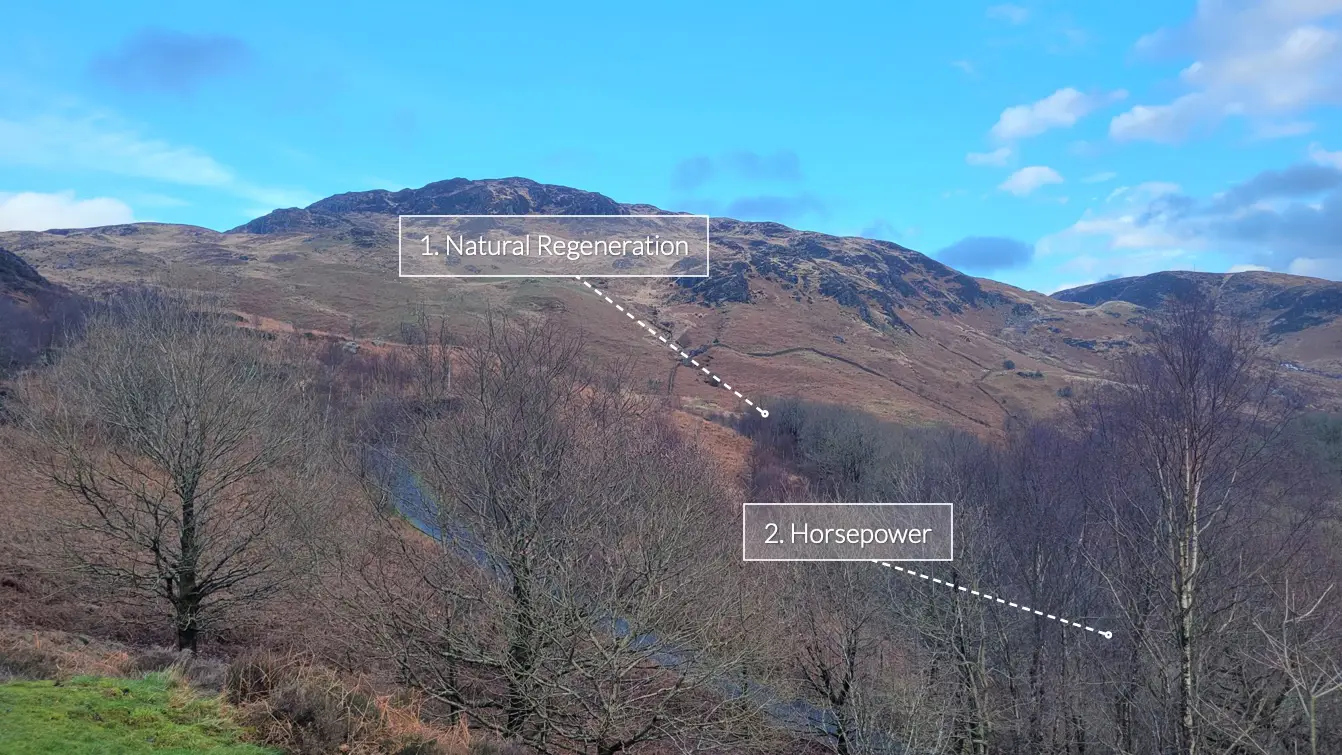
Our job is to plant and grow trees. However, why plant when we can let nature do the work for us? Around point 1 in the picture below you can see trees stretching up the hillside. This is all naturally regenerated birch and oak trees from the wood below. As the seeds have dispersed and been blown up the hill, saplings have taken root. This little area expands the native broadleaf woodland and makes a great habitat for various wildlife. With a little help from us to keep the deer in check, it should go on to develop into a mature woodland.
2. Horsepower
We recognise that we can't improve biodiversity without using natural solutions. That's why we're looking to nature, and sometimes the past, to uncover low impact methods for accomplishing our goals. Down in the native woods near the loch (point 2), the bracken needed thinning to allow new trees and plants to grow. A horse pulling a heavy roller proved ideal in the tight and twisty confines of the wood. Now the area has been opened up a little to allow a more diverse array of under-storey to develop. Simple, and very low impact.
3. Eagles, falcons and grouse
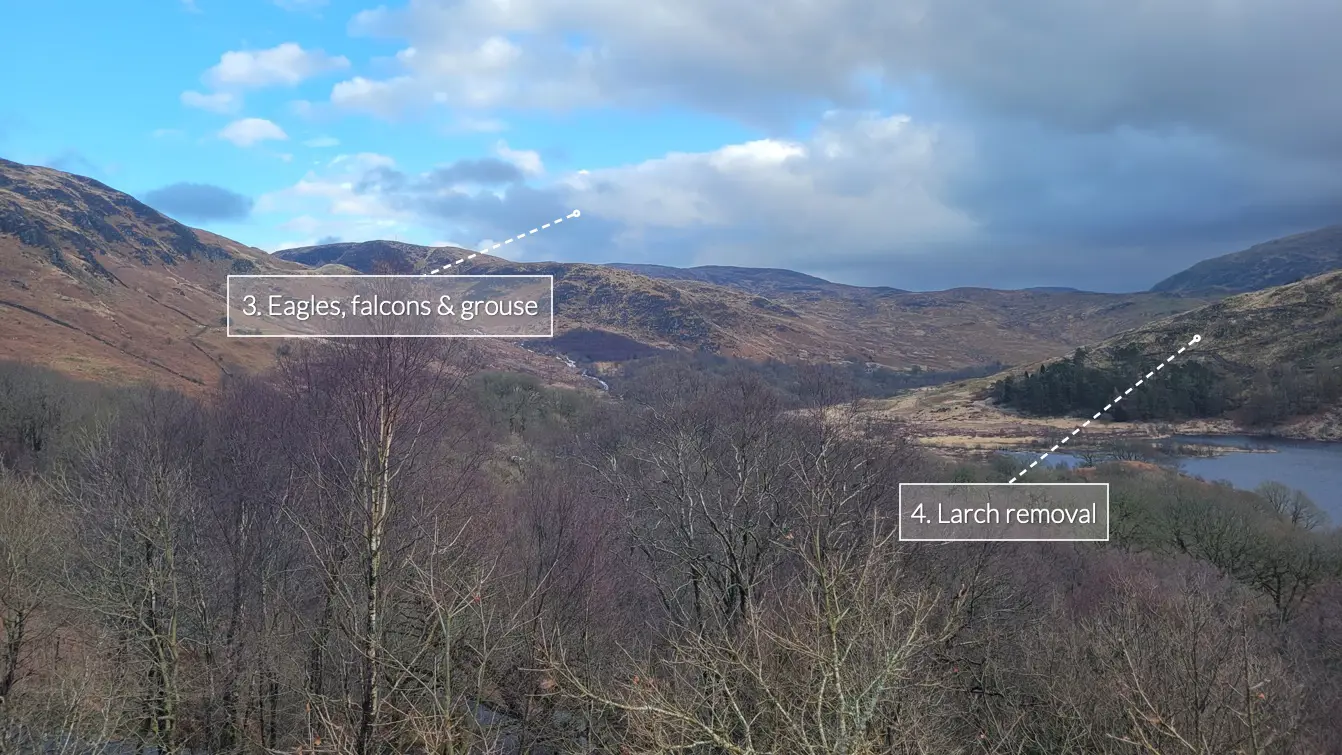
Just behind where this shot was taken is a steep hillside home to a peregrine falcon. And this area as a whole, at the centre of Galloway Forest Park, is home to two pairs of golden eagles. Plus, we’re restoring areas of the landscape in these parts to suit the endangered black grouse. You’ll be lucky to catch a glimpse of any of these wonderful creatures, but our local rangers and staff are doing their bit to see them thrive. From keeping an eye on the falcon chicks in summer and monitoring the eagles, and even listening out for grouse lekking calls. We’re not a wildlife agency, but part of our job is to ensure there are good quality habitats for a range of Scotland’s creatures.
4. Larch removal
Across the loch is an area of larch trees felled in the last couple of years. Galloway Forest Park has been hit hard by the disease P ramorum. This disease kills larch trees and has spread fast in southwest Scotland. We can’t cure the trees so we fell and remove them to help stop the disease from spreading, as well as using the larch for timber. Removing the trees also prevent any which are not dead from producing spores carrying the disease. The frontline of this disease is now some way beyond Loch Trool, but by removing the dead trees we can create space for replacement trees to be planted. In this location we are establishing native oak woodland using acorns collected from the local mature woodlands.
5. Deer and goats
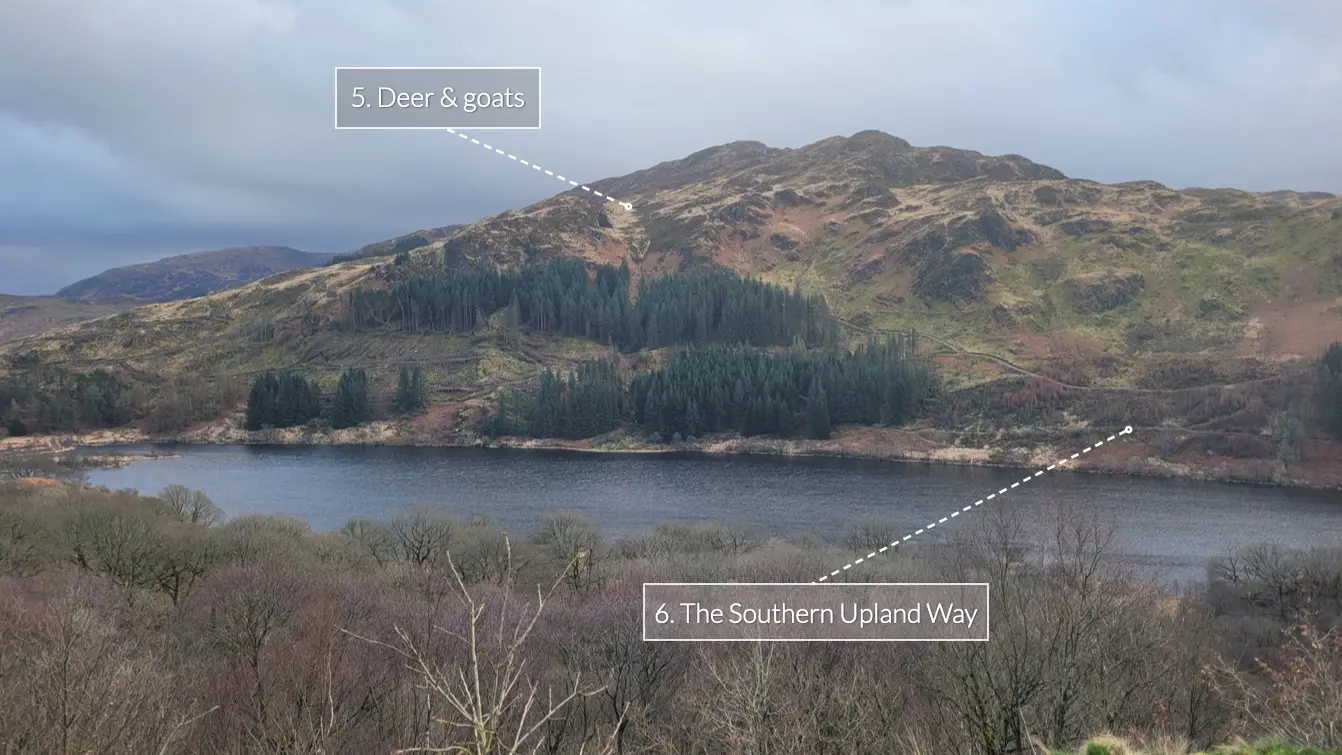
Back to animals, and this time it’s deer and goats. Deer are a Scottish icon, but there are just too many. Every year they cause damage to young forests costing us millions of pounds and considerable time replanting. Too many Deer also have a negative impact on the environment by overgrazing. We want to grow Scotland’s forests, to benefit the climate and biodiversity. Deer are a part of the environment but we need to work to keep them in check to allow new and re-planted forests to grow.
Alongside them here in Galloway Forest Park are wild goats. There aren’t many of them so it is a very localised problem. However, they can be quite aggressive in their munching of young trees! We do our best to encourage them to nibble elsewhere.
6. The Southern Upland Way
Across the loch is the Southern Upland Way. Reaching from west to east across Scotland, the trail here meanders up through the hills towards Clatteringshaws. It’s not the only trail here though. We’ve got 4 waymarked walking paths, three mountain bike trails, and you can start here to get up to the Merrick, the highest hill in southern Scotland. Our rangers keep an eye on all our trails regularly to keep them maintained.
Recreation is a big part of what we do. It’s great to see people visiting our forests and exploring landscapes across Scotland. Being outdoors and in the forest is good for your physical and mental health. Here in Glentrool is a great place to visit for anyone looking for a walk, run or ride. There is also a visitor centre where you can find out more information, pick up trail leaflets and enjoy some food and drink.
7. Larch regeneration
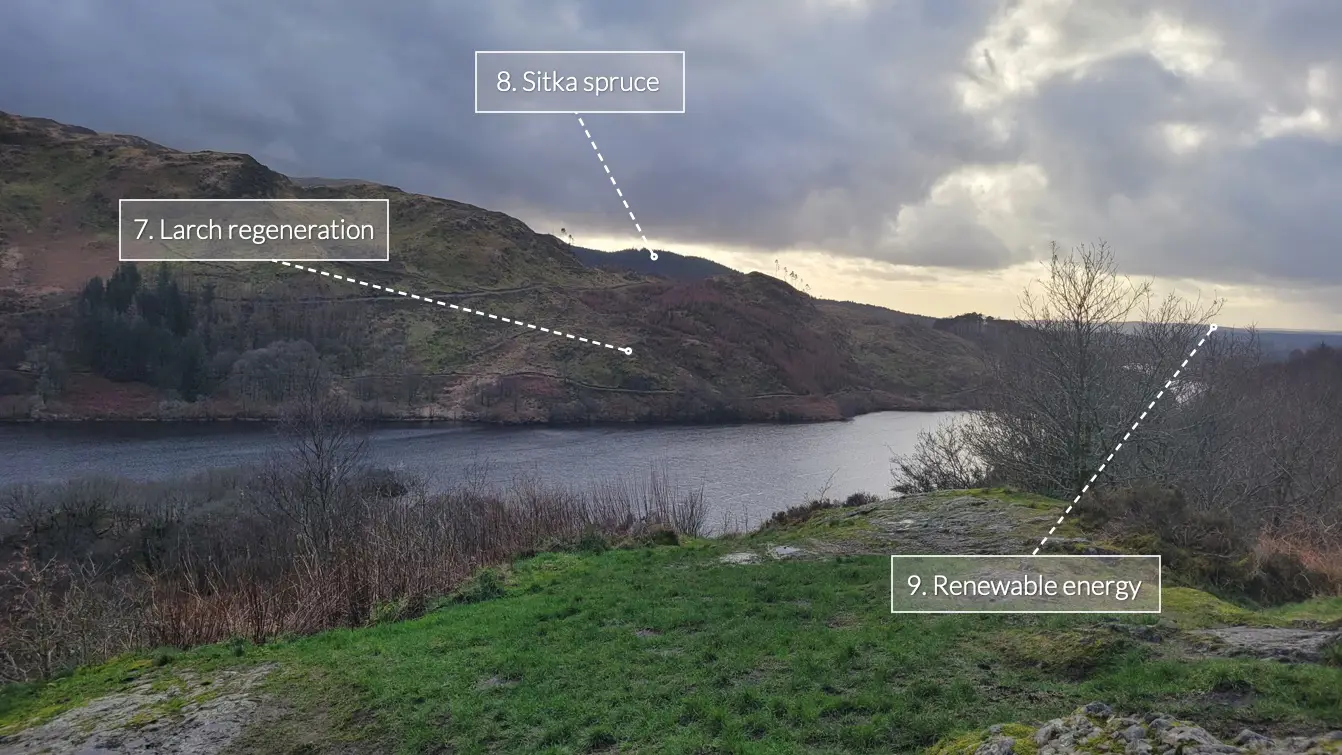
In a wonderful show of nature’s resilience, a site on which larch was felled due to disease is now springing up with a new generation of larch. Grown naturally from seeds left by the mature trees, this was not planned and poses some interesting questions. Is this new generation carrying the same disease as their parents? Should we remove them just in case, or give them a chance to grow (at the risk of spreading spores)? There are many unknowns which is why we’re working with Forest Research to see if there is any natural resistance to the disease to be found in nature. We regularly work with other organisations across the UK to make sure we can manage Scotland’s land to the highest standards.
8. Sitka spruce
Also across the loch and beyond are stands of Sitka spruce. This is Scotland’s dominant conifer and accounts for around half of all timber produced in the country. In Dumfries and Galloway it is particularly prevalent. The combination of soils, weather and salty sea air suit sitka well. In fact, considerably better than any other coniferous tree. There are some pines and firs, and even other varieties of spruce, but sitka is what grows well here with other species struggling and growing a lot slower.
Currently, the UK imports 80% of the timber it needs from overseas. If we are to de-carbonise our lives and become more sustainable, we will need even more timber to replace materials like plastic, steel and concrete. That’s why we will always have a considerable focus on timber producing trees like sitka.
9. Renewable energy
Out of sight but on the horizon is one of many wind farms in Dumfries and Galloway. We don’t operate any wind farms, but we do facilitate access to various companies and communities for renewable energy projects. The development of these sites is very detailed and takes many years of survey work and planning to arrive at an acceptable scheme that can be constructed in the forest.
If Scotland is to achieve Net Zero by 2045, we need more renewable energy. By offering our expertise and land in certain places we can play our part in achieving this.
From this one spot, we can see a whole range of ongoing projects to manage this wonderful landscape. There is a lot of work that goes on in the background to make all this possible, including by the local Planning and Environment team, Civil Engineers, Delivery team, Deer Management rangers and Visitor Services. Plus the supportive work of our Procurement, Finance, HR, Admin, Digital, Design and Communications teams. Our organisation works in a vast number of areas. If you stop to look around, you'll discover all sorts.