Forestry and Land Scotland Logo
  1. Visit
      1. Find a forest
      2. Explore forest parks
    1. Accessible forests
    2. Stay the night
      1. Waymarked trails
      2. Cycling
      3. Mountain biking
      4. Photography
      5. Orienteering
      6. Camping
      7. Treetop adventure
      8. Water sports
      9. Horse riding
      1. Things to see
      2. Trees
      3. Wildlife
      4. Heritage
      5. Things to see in Winter
    3. Plan a visit with a group
    4. Visiting safely
    5. Parking
    Forest map

    Search for a forest by map

    Forests & trails information and closures

    An overview of all closures and high risk warnings on trails.

    Stay the night

    Park overnight in selected forest car parks as part of our motorhome scheme.

  2. About us
      1. Who we are
      2. Our mission and vision
      3. Leadership team
      4. Our values
      1. Careers
      2. Current Vacancies
      3. What we offer
      4. Candidate information
      5. A day in the life
      6. Apprenticeships
    1. Key documents
    2. Our impact
    3. Our approach to Gaelic
    Current Vacancies

    Some text

  3. What we do
      1. Taking Climate Action
      2. The climate emergency
      3. Forest resilience
      4. Peatland restoration
      5. Carbon offsetting
      6. Biodiversity
      7. Renewable energy
      1. Managing the land
      2. Planning our land management
      3. Our sustainable forestry
      4. Our tree nursery
      1. Conservation
      2. Habitat conservation
      3. Wildlife conservation
      4. Historic environment conservation
    1. Supporting outdoor exploration
    2. Working with communities
    3. Our projects
  4. Living and Working
      1. For businesses
      2. Timber sales
      3. Procurements and tenders
      4. Business opportunities
      5. Farming opportunities
      6. Venison sales
      7. Firewood sales
      1. For communities
      2. Transfer land and buildings to your community
      3. Land management plan consultations
      1. Permissions and Permits
      1. Learning and Education
      2. Outdoor learning
      3. Activity sheets
    1. Buy Land or Buildings
    Land management plan consultations

    Text here

    Current job opportunities

    Text here

  5. Get involved
    1. Have your say on consultations
    2. Hold an event
    3. Apply for a community asset transfer (CAT)
    4. Arrange a visit
    5. Work with us
  6. News
  7. Contact
Suggested links
    1. Home
    2. News
    04 July 2022 4 minutes

    A subterranean secret
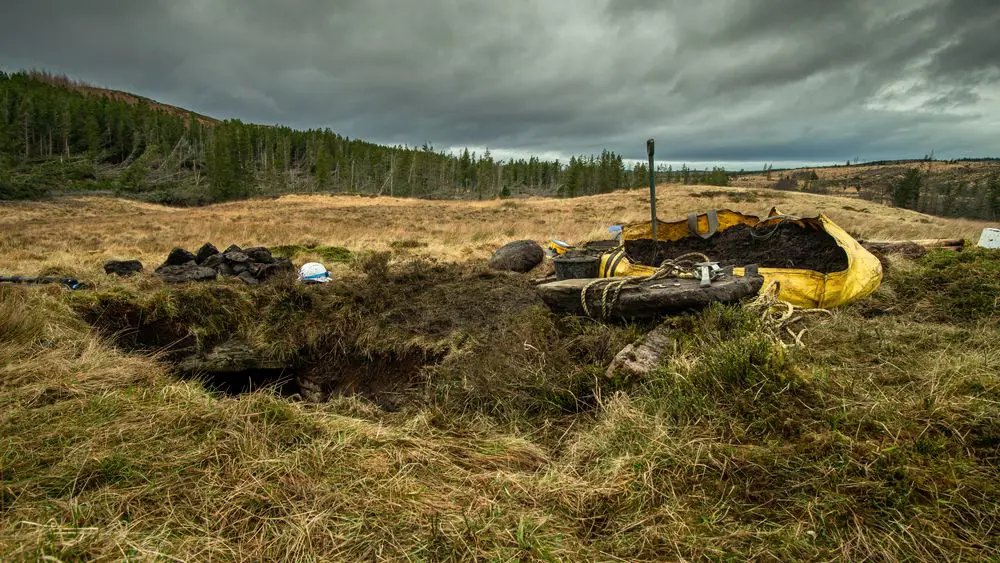
    A hole in the ground with a yellow bag of mud next to it and a shovel

    Most people don’t consider archaeology when they think about forestry, but it’s an important part of our stewardship of Scotland’s national forests and land.  

    We manage many interesting and important archaeological sites across Scotland and are finding and protecting more each year. This can involve creating detailed records of significant sites, developing conservation plans to ensure that heritage and visitors are looked after, and investigating and presenting the stories they can tell.

    A tight squeeze

    The remote Iron Age souterrain (or cellar) of Cracknie in Borgie Forest in Sutherland was built over 2000 years ago. Measuring over 13m in length, and about 1m in height, the narrow curving passage slopes downwards to reach a small chamber at the end. The entrance is marked by a narrow hole in the ground – no stairway or above ground structure survives. The walls are carefully built without mortar and it is roofed with large lintel stones overlapping each other.

    Cracknie Souterrain is one of the best-preserved Iron Age souterrains in Scotland, and is one of the most important scheduled monuments on Scotland’s national forests and land.

    Souterrains are still an enigma. They were usually built below a large timber roundhouse, and may have been used as cold cellars to store food such as cheese and butter, or as a secure place to house slaves or hostages. They may even have been used for religious and spiritual activities.

    Surveying underground

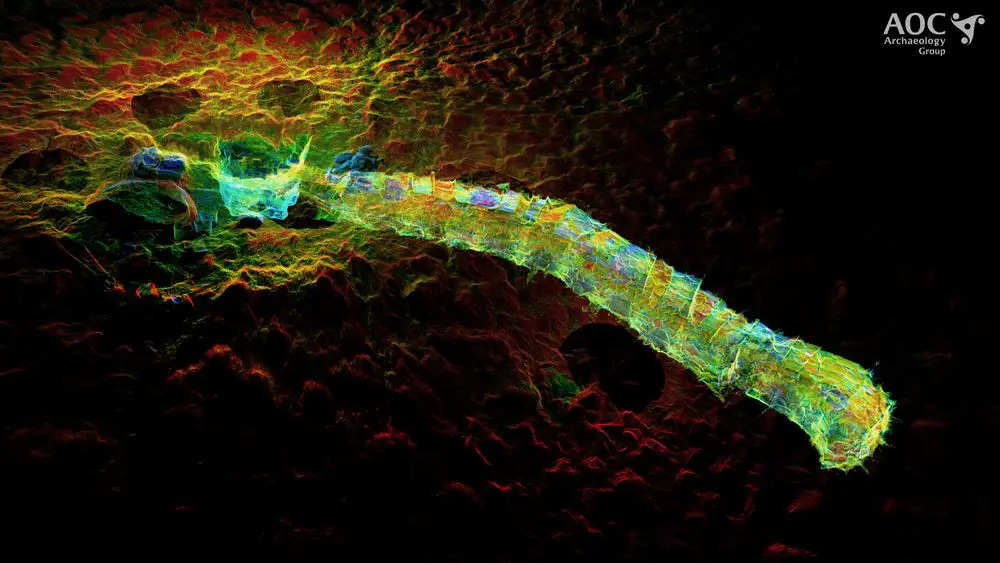
    The souterrain was recently the subject of an archaeological measured survey by AOC Archaeology. The survey used modern laser scanning techniques to create a stone-by-stone architectural record. The survey results illustrate the well-preserved walls and roof lintels, and supported the excavation of the entrance passage, opening the narrow hole to enable safe access.


    This time-lapse video shows the archaeologists first excavating the narrow entrance and removing a collapsed lintel stone. It then shows the conservation stonemason rebuilding the side walls of the now consolidated access way. The archaeological excavation did not uncover any steps down into the souterrain, so it’s likely that the current access is down through the collapsed roof into the passage, and that the original entrance remains buried.

    This video shows the 3D point cloud generated by the laser scan survey. You can see where the archaeologists were excavating at the entrance. At the time of the laser scan, they had lowered the ground surface but had not yet opened up the narrow neck of the passageway. The subterranean nature of the space is easy to appreciate. The white wave is a clipping plane, effectively ‘slicing’ through the 3D model – first as a vertical plane from the side, and then as a horizontal plane from above. The dark circles on the ground are scanner positions – the data was collected by scanning above and below ground, and then stitching the two datasets together.
    a 3D scan of an underground cellar

    This image is a view of the 3D point cloud of the souterrain from above. The colours indicate the laser reflectance intensity of every stone in the walls. To understand the image, look for the entrance excavation (on the left hand side) and imagine crawling through the narrow neck of the passage way before crouching low under the lintel stones (visible in the roof of the 3D structure) to reach the chamber at the end, the deepest part of the structure.
    Cracknie Souterrain cartoon people building an underground cellar

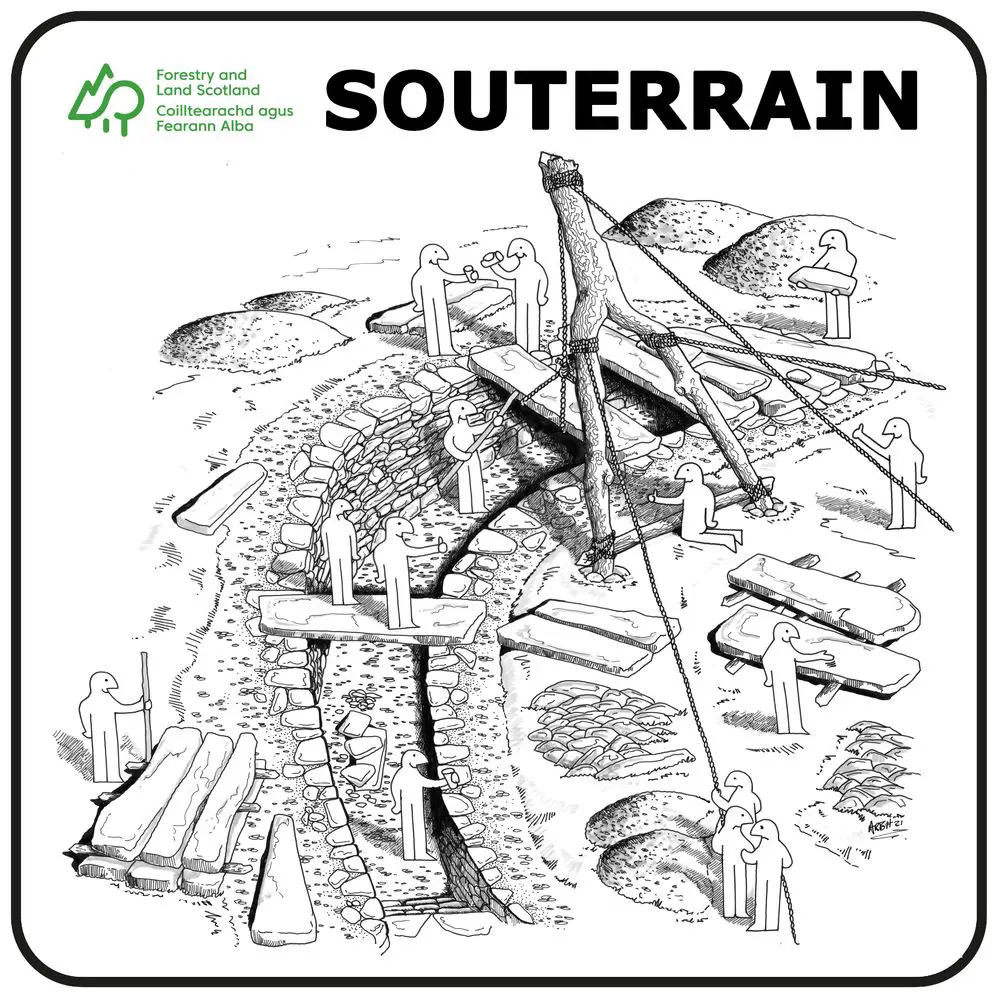
    This drawing by Alan Braby imagines the construction of the souterrain – first cut as a trench, and then lined with stones, with the heavy lintels finally lifted into place to roof the passage.


    Latest from FLS

    1. 12 Jan 2026

      Lesley's article

    2. 03 Oct 2025

      Scotland's Climate Week 2025: Working together in the Angus Glens

    3. 29 Sep 2025

      Scotland's Climate Week 2025: Working with partners to support beaver populations

    4. 19 Sep 2025

      Martens on the Move at Kirroughtree

    5. 20 Aug 2025

      Protecting endangered apple trees through teamwork

    Share this article

    • Share on Facebook
    • Share on X
    • Share on LinkedIn

    Feedback

    There is a problem

    Feedback

    Thank you for your feedback

    User feedback form


    Your feedback helps us to improve this website. Do not give any personal information because we cannot reply to you directly.


    Your feedback helps us improve this website. Do not provide any personal information here. If you need to get in touch with a query, please contact us.


    Your feedback helps us improve this website. Do not provide any personal information here. If you need to get in touch with a query, please contact us.

    Forestry and Land Scotland Logo

    Follow us on

    • Forestry and Land Scotland on Facebook
    • Forestry and Land Scotland on Twitter
    • Forestry and Land Scotland on Instagram
    • Forestry and Land Scotland on LinkedIn

    Utilities

    1. Accessibility
    2. Cookies
    3. Privacy Notice
    4. Terms and Conditions
    5. Freedom of Information
    6. Modern Slavery Statement

    Quick links

    1. Media Centre
    Forest Stewardship Council, the mark of responsible forestry Programme for the Endorsement of Forest Certification, PEFC
    © Crown Copyright
    Forests and land that Scotland can be proud of Link to gov.scot gov.scot